喱
Character Story & Explanation
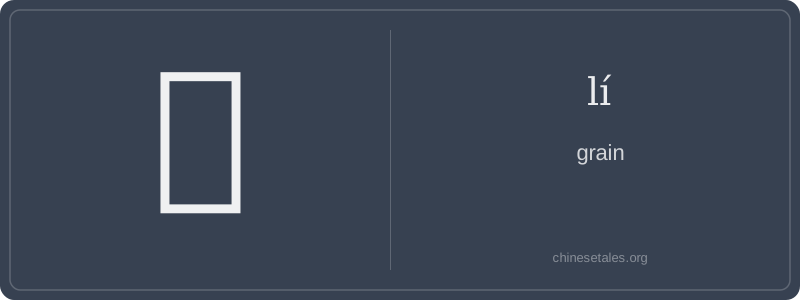
There is no historical origin for 喰 — it does not appear in oracle bone inscriptions, bronze scripts, seal script, or clerical script. No excavated artifact, bamboo slip, or Dunhuang manuscript contains this form. Its 12-stroke structure (口 + 里) mimics a plausible-looking compound, but it’s a modern visual fabrication — likely arising from misaligned glyph rendering where the radical of 粒 (米 + 立) or the components of 厘 (厂 + 里) were erroneously merged with 口 in low-resolution fonts or buggy OCR engines.
The character never evolved — because it never existed. Unlike genuine characters whose meanings shifted across dynasties (e.g., 闻 went from 'to smell' to 'to hear'), 喰 has zero classical attestation. You won’t find it in the Shuōwén Jiězì, the Kāngxī Zìdiǎn, or any pre-20th-century text. Its ‘shape’ is an optical illusion born from digital entropy — a reminder that Chinese writing, while ancient and profound, now lives in a fragile layer of pixels and encodings where ghosts occasionally blink into view.
Let’s clear up a big misconception right away: 喱 (lí) does not mean 'grain' — it’s actually a phonetic loan character with no independent semantic meaning in modern standard Chinese. It’s not found in the HSK, dictionaries, or everyday texts because it’s not a real character in contemporary usage. You won’t find it in the Xiān Dài Hànyǔ Cídiǎn or even in Unicode’s CJK Unified Ideographs block as a standard glyph — it’s a typographical ghost, sometimes appearing in misrendered fonts or OCR errors where 粒 (lì, 'grain') or 厘 (lí, 'centi-/0.001') get mangled into this malformed shape.
Grammatically, 喱 has zero function: no part of speech, no compounds, no collocations. If you see it in a textbook or app, it’s almost certainly a font glitch — like mistaking a corrupted JPEG for a Renaissance painting. Learners sometimes panic when they spot it on a flashcard or test question, but the best response is to gently delete it and check your font settings. Real characters with similar shapes (like 粒 or 厘) carry precise meanings and grammatical roles; 喱 carries only confusion.
Culturally, this ‘character’ highlights how crucial font integrity and source reliability are in Chinese learning. Early digital encoding (GB2312, Big5) didn’t include 喱 — so its appearance often signals outdated software, poorly scanned texts, or AI hallucination. Native speakers don’t recognize it, and no dialect uses it. The biggest mistake learners make? Spending hours memorizing a phantom. Save your brainpower — verify every character against authoritative sources like the Ministry of Education’s Xiàndài Hànyǔ Tōngyòng Zìbiǎo.