喏
Character Story & Explanation
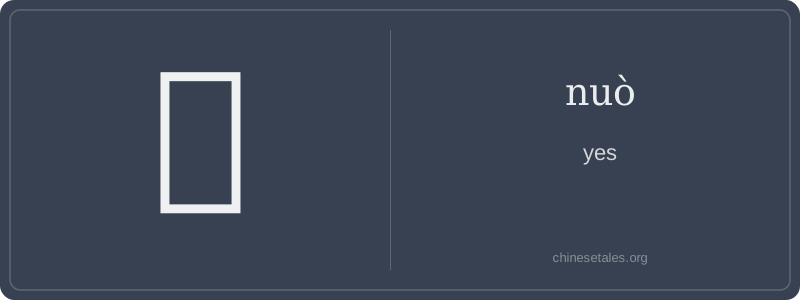
The earliest form of 喏 appears in seal script as 口 + 若 — not a pictograph of an object, but a phonetic-semantic compound. The 口 (mouth) radical signals speech, while 若 (ruò) served both as a phonetic hint (ancient pronunciation was closer to *njaɡ*) and a semantic anchor: 若 meant 'to comply' or 'as if', suggesting verbal agreement. Over centuries, the top part simplified from the full 若 (11 strokes) to the streamlined version we see today — note how the grass radical (艹) became two dots, the 'mouth' inside 若 collapsed into a horizontal stroke, and the 'hand' (又) morphed into the final捺 (nà) stroke.
This evolution mirrors its semantic journey: from classical texts like the Zuo Zhuan, where 喏 appeared in ritual contexts to signal respectful assent ('喏,遵命!'), to Ming-Qing vernacular fiction, where it became the go-to interjection for servants, shop clerks, and humble speakers. Its visual compactness — 11 strokes balanced around 口 — reflects its function: a concise, mouth-initiated act of yielding consent. Even today, when someone says 喏, they’re not just speaking — they’re performing a tiny, graceful bow with their voice.
喏 is a charmingly archaic, almost theatrical 'yes' — not the neutral shì or casual èn you’ll hear daily, but a polite, slightly deferential affirmation, often with a gesture (a slight bow or hand wave). Think of it as the Chinese equivalent of saying 'Yes, sir!' with a tip of the hat. It’s pronounced nuò (fourth tone), and while rě exists as a rare literary variant (e.g., in classical poetry meaning 'to point'), nuò is the only pronunciation you’ll need for modern spoken use.
Grammatically, 喏 functions as an interjection — always standing alone or at the start of a sentence, never as a verb or adjective. You’ll hear it from shopkeepers handing over change ('喏,找您的钱!'), elders acknowledging a request ('喏,这就来!'), or characters in period dramas accepting orders. Crucially, it’s *not* used in questions ('Is that okay?' → no 喏) or formal writing — dropping it into an email would sound bizarrely theatrical.
Culturally, 喏 carries warmth and social awareness: it signals attentiveness and readiness to serve or comply. Learners often mistakenly treat it like a synonym for 是 — but using 喏 where 是 is expected sounds jarringly old-fashioned or sarcastic. Also, don’t confuse its tone: nuò (like 'noh') is firm and clear; mispronouncing it as nuō (first tone) makes it sound like 'I’m dragging something' — a hilarious blunder!