唡
Character Story & Explanation
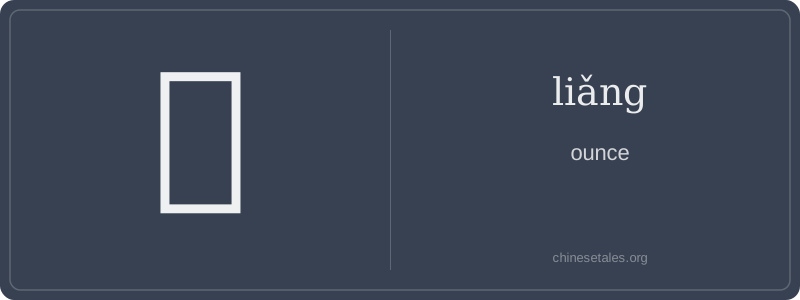
There is no oracle bone or bronze script for 唡 — because it didn’t exist before the 1920s. It’s a deliberate, modern coinage: a radical-phonetic character constructed from scratch. The left side 口 (kǒu, 'mouth') was chosen purely as a semantic classifier for 'words/sounds' — signaling this is a phonetic loan, not a meaning-based character. The right side 两 (liǎng, 'two') was selected solely for its sound, not its meaning — an audacious act of linguistic bricolage. Visually, it looks like 口 + 两, but the 两 here is stripped of its ancient pictographic roots (originally two hands holding a pair of jade bi discs); now it’s just a sound-bearer.
This character emerged during the Republic of China’s standardization drive, when committees needed characters to represent foreign units without adopting Latin script. 唡 first appeared in the 1932 'Table of Standardized Characters for Weights and Measures'. Unlike classical characters shaped by millennia of calligraphic evolution, 唡 was designed on paper — measured, justified, and approved. Its 'history' is bureaucratic, not literary: no Confucian text cites it; no Tang poem rhymes with it. Yet its very artificiality tells a deeper story: how Chinese absorbed Western science not through conquest, but through careful, character-by-character translation — turning 'ounce' into a mouth-shaped echo of 'two'.
Imagine you’re bargaining in a dusty antique market in Chengdu, haggling over a vintage silver teapot. The vendor holds up two fingers and says, 'Liǎng! Liǎng!' — not meaning 'two', but 'two ounces' of pure silver weight. That’s 唡 in action: a borrowed, phonetic character that exists solely to transliterate the English word 'ounce' (pronounced /aʊns/ → liǎng). It carries zero native Chinese semantic weight — no ancient philosophy, no poetic resonance. It’s a linguistic placeholder, born in the early 20th century when Western measurements flooded China’s apothecary shops, pharmacies, and gold markets.
Grammatically, 唡 functions only as a measure word — never standalone, never as a verb or adjective. You’ll always see it after a number: yī liǎng (一唡), sān liǎng (三唡). Crucially, it’s *not* interchangeable with the native Chinese unit liǎng (两) — even though they share pronunciation and tone. Using 唡 instead of 两 for traditional Chinese weight (e.g., 'I bought five liǎng of tea') is instantly flagged as foreign-influenced or outdated. Learners often misread 唡 as 两 and assume they’re synonymous — a subtle but culturally telling error.
In practice, 唡 is nearly extinct in daily life. Most modern contexts use 克 (gē, gram) or standard metric units. You’ll still spot it in old pharmaceutical labels, vintage cocktail recipes, or historical novels set in 1930s Shanghai — a quiet fossil of Sino-Western contact. Its survival isn’t due to utility, but to typographic inertia: once typeset in lead, it lingered in printing manuals long after its practical use faded.