唁
Character Story & Explanation
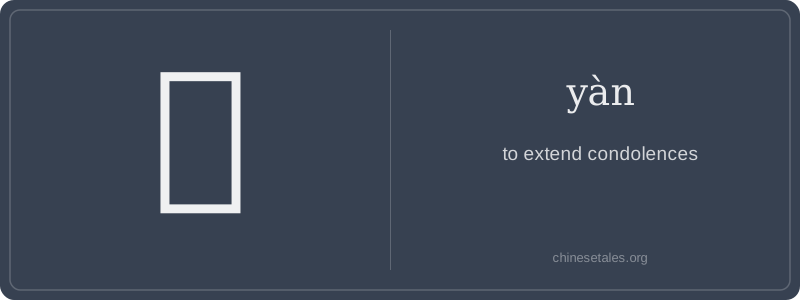
The earliest form of 唁 appears in bronze inscriptions (c. 1000 BCE) as a composite: a mouth radical (口) on the left, and 口 + 丷 + 干 on the right — later standardized as 言 (yán, 'speech') plus 兊 (duì, an archaic variant of 兑, meaning 'to exchange' or 'to present'). The oracle bone precursors show two mouths facing each other — symbolizing solemn, reciprocal words exchanged in mourning. Over centuries, the right side simplified: 兊 evolved into the modern 兑 (with dot and vertical stroke), and the whole character stabilized by the Han dynasty into today’s 10-stroke form: 口 + 兑.
This visual duality — two mouths, speaking in turn — mirrors its classical function: not monologue, but ritual dialogue between the mourner and the bereaved. In the Zuo Zhuan (c. 4th c. BCE), 唁 appears in records of feudal lords sending envoys to 'speak words of sorrow' (唁辞 yàncí) after a ruler’s death — establishing its link to statecraft and hierarchy. Its sound (yàn) also echoes 言 (yán, 'speech'), reinforcing that this is *ritual speech*, not spontaneous emotion. Even today, the shape whispers: 'mouths exchanging gravity.'
At its heart, 唁 (yàn) is a formal, solemn verb meaning 'to extend condolences' — but it’s not casual sympathy. Think of it as the linguistic equivalent of bowing deeply at a funeral: respectful, restrained, and socially prescribed. It’s never used for minor losses (like a broken phone), only for deaths — and almost always in written or ceremonial contexts, not everyday speech. You’ll see it on condolence cards (唁电 yàndiàn, 'condolence telegram'), in official announcements, or when dignitaries visit bereaved families.
Grammatically, 唁 is transitive and usually paired with an object: 唁慰 (yànwèi, 'to console') or 唁吊 (yàndiào, 'to mourn and pay respects'). It rarely stands alone — you won’t say 'I yàn-ed' without specifying *whom* (e.g., 唁慰家属 yànwèi jiāshǔ, 'console the bereaved family'). Learners often mistakenly use it like 慰问 (wèiwèn, 'to visit and comfort'), which applies to illness or disaster; 唁 is death-exclusive. Also, it’s almost never used in the first person in spoken Chinese — saying 'I 唁 you' sounds stiff, even cold, unless you’re a government official reading a statement.
Culturally, 唁 reflects Confucian emphasis on ritual propriety (lǐ 礼) in grief: mourning isn’t just emotional — it’s performed correctly through language, gesture, and timing. Misusing it (e.g., in a lighthearted context) can unintentionally offend. And crucially: while English says 'offer condolences,' Chinese uses 唁 *to* someone (e.g., 唁慰他 yànwèi tā), not 'on behalf of' — the focus is direct, personal respect toward the living who grieve.