哽
Character Story & Explanation
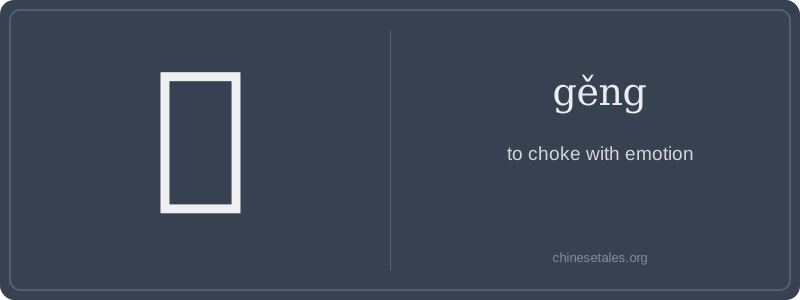
The earliest form of 哽 isn’t found in oracle bones, but its components tell a clear tale: left side 口 (kǒu, 'mouth'), right side 更 (gēng, originally depicting a hand holding a tool to strike or change — later meaning 'to change, to replace'). In bronze inscriptions, 更 showed a hand (又) atop a bell-shaped vessel (丙), symbolizing ritual alteration. Over centuries, the right side simplified to today’s 更 — still evoking forceful intervention — while 口 remained steadfast. So visually: 'mouth + forceful change' = a throat violently disrupted, not by food, but by inner upheaval.
This semantic link solidified in classical texts: the Shuōwén Jiězì (121 CE) defines 哽 as 'qi blocking the throat', linking it to qi (vital energy) stagnation — a concept central to traditional medicine and emotion theory. By the Tang dynasty, poets used 哽咽 to describe suppressed sorrow in elegies; by Ming-Qing fiction, it became the go-to for tearful farewells where characters ‘couldn’t utter a word’. The character’s visual duality — calm mouth radical paired with dynamic, disruptive 更 — perfectly mirrors its meaning: outward silence masking inner turbulence.
Imagine your friend Li Wei, eyes suddenly welling up as he tries to thank his grandmother for raising him alone — he opens his mouth, but no words come out; his throat tightens, breath catches, voice cracks. That visceral, wordless emotional blockage? That’s 哽 (gěng). It’s not physical choking on food (that’s 噎 yē), nor is it sobbing (哭 kū); it’s the precise, poignant moment when overwhelming feeling — gratitude, grief, love, shame — physically constricts the throat and silences speech.
Grammatically, 哽 most often appears in the reduplicated form 哽哽 (gěng gěng) or with verbs like 哽住 (gěng zhù, 'to choke up') or 哽咽 (gěng yè, 'to choke back sobs'). You’ll rarely see it standalone: it’s almost always part of a compound or verb phrase describing *how* speech fails — e.g., 他哽住了 (tā gěng zhù le) — 'He choked up.' Learners mistakenly try to use it like a noun ('a choke') or as a transitive verb without particles, but it’s inherently descriptive and action-embedded.
Culturally, this character captures a deeply valued Chinese restraint: emotion is felt intensely, yet its expression is often muted, internalized — the physical symptom *is* the confession. Western learners sometimes overuse it, applying it to mild sadness, but in native usage, 哽 carries weight — it signals profound, unspoken depth. Also, beware: it’s easily misread as 品 (pǐn) or 梗 (gěng), but those mean 'item' and 'sticking point' respectively — totally unrelated!