哩
Character Story & Explanation
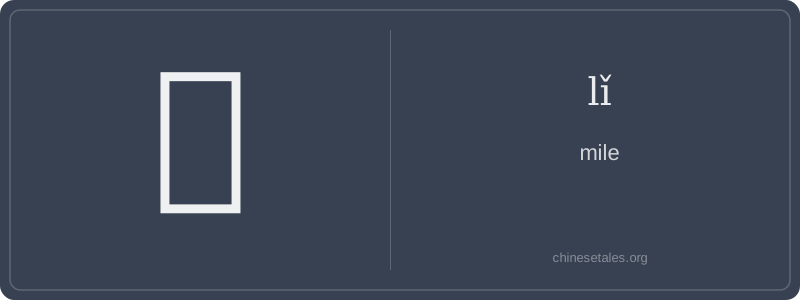
The character 哩 has no ancient pictographic origin — it was invented during the Qing dynasty's late period as a purpose-built phonetic loan. Its earliest attested form appears in early 20th-century bilingual dictionaries and maritime manuals. Visually, it merges 口 (kǒu, 'mouth', indicating phonetic function) on the left with 里 (lǐ, 'village/distance unit', chosen for its sound, not meaning) on the right. The 10 strokes crystallized quickly: 口 (3 strokes) + 里 (7 strokes), with the 里 component retaining its standard structure — top 田 (field), middle 土 (earth), bottom 一 (horizontal line), though here it serves purely as a sound cue, not a semantic one.
This deliberate fusion reflects a fascinating moment in Chinese lexical history: when translators needed precise, unambiguous terms for foreign concepts without semantic baggage. Unlike 里 — which carried centuries of administrative, poetic, and spatial connotations (e.g., 万里 (wàn lǐ, 'ten thousand li', symbolizing vastness or hardship) — 哩 was sterile, technical, and intentionally foreign-sounding. It appears in early Republican-era naval regulations and British-Chinese treaties, always paired: 英哩, 海哩. Classical texts never use it; even the 1915 Kangxi Dictionary omits it entirely. Its visual pairing of 'mouth' + 'village' ironically evokes 'speaking of distance' — a perfect mnemonic for its role as a mouthed transliteration.
At first glance, 哩 (lǐ) looks like a straightforward unit word — 'mile' — but it’s actually a linguistic chameleon. Unlike native Chinese distance units like 里 (lǐ, also 'mile', but traditional Chinese measurement ≈ 500m), 哩 is a phonetic loan character borrowed in the late 19th–early 20th century to transliterate the English word 'mile' (as in imperial mile: 1,609m). It carries no inherent meaning of its own — the 口 (mouth) radical signals it’s a sound-based borrowing, not a semantic one. You’ll almost never see it alone; it only appears in compound transliterations like 英哩 (yīng lǐ, 'English mile') or 海哩 (hǎi lǐ, 'nautical mile').
Grammatically, 哩 functions strictly as a measure word suffix — always attached to a number and a modifying noun (e.g., 十英哩, shí yīng lǐ, 'ten miles'). It never takes classifiers like 个 or 份, and crucially, it’s *not* interchangeable with 里 (lǐ). Saying 我跑了五哩 (wǒ pǎo le wǔ lǐ) sounds like you’re quoting a 1920s Shanghai newspaper — technically intelligible but archaic and jarringly foreign-sounding today. Modern Mandarin uses 公里 (gōng lǐ) for metric kilometers and almost never uses 哩 outside technical, historical, or dialectal contexts.
Culturally, 哩 is a time capsule of China’s encounter with Western measurement systems during treaty-port modernization. Learners often mistakenly treat it as a synonym for 里 — a costly error that can turn 'five kilometers' into 'five imperial miles' (a 60% difference!) or worse, confuse it with the sentence-final particle 哩 (li, toneless, used in some dialects for emphasis), which shares the same shape but zero relation. Its rarity in spoken Mandarin means encountering it usually signals either a vintage text, a nautical chart, or a very meticulous historian.