咂
Character Story & Explanation
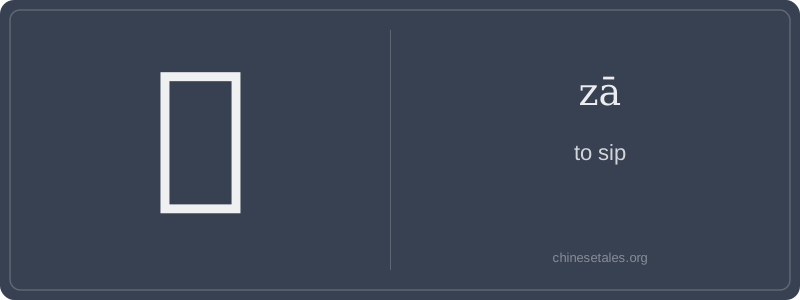
The earliest form of 咂 appears in late Warring States bamboo slips, not oracle bones — and it’s brilliantly literal. It combined 口 (mouth) with 乍, which itself evolved from a pictograph of a person standing upright with arms raised in surprise — but here, 乍 was borrowed for its sound (zhà → zā) and repurposed visually: the three horizontal strokes above the 'person' element subtly echo lips parting, while the vertical stroke anchors the 'suction pull'. Over centuries, the 'person' simplified into the modern 乍 shape — two short slants and a dot above two horizontals — and the mouth radical anchored it firmly as an oral act.
This character didn’t appear in the earliest classics like the Shījīng, but blossomed in Ming-Qing vernacular fiction and regional opera scripts, where vivid sound-imitation mattered. In the 17th-century novel *The Plum in the Golden Vase*, characters 咂酒 (zā jiǔ) — not just 'drink wine', but *draw its aroma and heat slowly into the mouth*. The visual logic holds: 口 is the stage, and 乍 — though homophonous with 'sudden' — became a phonetic anchor that *feels* abrupt and precise, mirroring the sharp intake of breath before suction. It’s a rare case where sound borrowing and semantic intuition fused perfectly — the shape doesn’t depict sipping, but its components *perform* it.
Think of 咂 (zā) as the *sound-effect character* for sipping — not gulping, not drinking, but that slow, deliberate, almost meditative 'slurp-suck' you do with hot tea, rich soup broth, or even a melting popsicle. It’s visceral and onomatopoeic: the mouth radical 口 tells you it’s oral action, and the right side 乍 (zhà) — originally meaning 'sudden' or 'startling' — hints at the quick, focused *initiation* of suction. This isn’t polite dinner-table vocabulary; it’s intimate, sensory, and slightly rustic — you’ll hear it more in novels, dialect speech, or poetic descriptions than in formal reports.
Grammatically, 咂 is almost always a verb, used transitively (with an object) or intransitively, often reduplicated for emphasis: 咂咂 (zā zā) mimics the repeated lip-smacking sound. Unlike generic verbs like 喝 (hē, 'to drink'), 咂 implies *drawing liquid inward with lips and tongue*, usually small amounts, sometimes with appreciation ('He sipped the aged baijiu, savoring each drop'). Learners mistakenly use it like 喝 — but try saying '我咂水' (wǒ zā shuǐ) to mean 'I drink water', and native speakers will picture you sucking water from a straw like a curious toddler — charming, but wildly inappropriate for everyday hydration.
Culturally, 咂 carries warmth and attentiveness: a grandmother 咂着药汁 (zā zhe yào zhī, 'sipping herbal decoction') conveys care and patience; a poet 咂着月光 (zā zhe yuèguāng, 'sipping moonlight') turns metaphor into tactile magic. Avoid overusing it — it’s a spice, not a staple. And never confuse it with similar-looking characters (see 'similar' below); one stroke off, and your elegant sip becomes a startled gasp or a bitter sigh.