呃
Character Story & Explanation
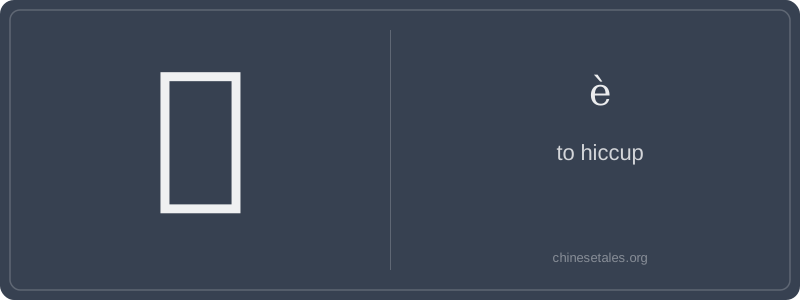
The earliest form of 呃 isn’t found in oracle bones — it’s a relatively late arrival, born from phonetic-semantic compounding during the Warring States period. Its left side 口 (kǒu, 'mouth') is straightforward — a pictograph of an open mouth, unchanged since Shang dynasty inscriptions. The right side '厄' (è, originally meaning 'to obstruct' or 'a narrow pass') began as a bronze script character showing a person trapped under a bent beam — later simplified into the modern '厄'. When combined around the 3rd century BCE, 口 + 厄 visually suggested 'a mouth blocked mid-sound' — a perfect graphic metaphor for the abrupt, involuntary catch of a hiccup or verbal stumble.
This visual logic held: by the Han dynasty, 呃 appeared in texts like the Shuōwén Jiězì as a 'sound-stopping syllable' — not just for physical hiccups, but for any vocal interruption. In Tang poetry, it occasionally punctuated rhetorical questions for dramatic pause ('呃!君不见黄河之水天上来?'), and by Ming-Qing vernacular fiction, it had fully evolved into the conversational filler we know today — retaining its ancient 'blocked mouth' essence while softening into polite hesitation. The stroke count (7) mirrors its compact, staccato function: quick, light, and impossible to ignore.
At first glance, 呃 (è) looks like a simple onomatopoeic hiccup — and it is! But in real Chinese speech, it’s far more than that: it’s a vocal pause with personality. Unlike English 'uh' or 'um', which signal hesitation, 呃 often carries gentle self-awareness, mild embarrassment, or even playful deflection — think of someone chuckling mid-sentence after a tiny social misstep. It’s rarely written formally, but appears constantly in dialogue-heavy novels, subtitles, and spoken-language transcripts.
Grammatically, 呢 is a particle; 呃 is *not*. It functions as an interjection — never as a verb, noun, or modifier. You’ll never say '他呃了三声' (✗); instead, you’ll hear '呃…其实我还没看' ('Uh… actually, I haven’t read it yet'). Notice how it stands alone or leads a clause, always followed by a pause — no attached objects, no complements. Learners sometimes wrongly treat it as a verb meaning 'to hiccup' and try to conjugate it (e.g., '呃过', '呃着') — but native speakers would find that jarringly unnatural.
Culturally, 呃 reflects the Chinese value of linguistic softness: rather than bluntly correcting oneself or interrupting, speakers use this tiny, breathy sound to cushion transitions — a subtle act of face-saving for both speaker and listener. Mistake it for the verb 打嗝 (dǎ gé, 'to hiccup') and you’ll sound either cartoonish or overly literal. And crucially: while 呃 *can* mimic hiccups, its primary role is pragmatic, not physiological — it’s less about the body and more about the rhythm of human connection.