厓
Character Story & Explanation
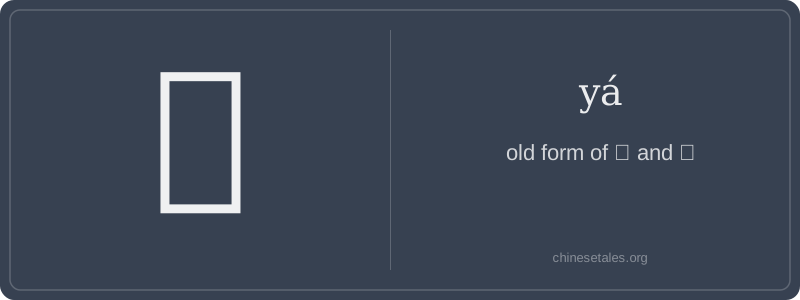
The earliest form of 厓 appears in late Warring States bamboo texts and Han dynasty seals — not in oracle bones, but in elegant clerical script. It began as a clear pictograph: the left 厂 represented a cliff face or overhanging rock shelter, while the right side was originally 亞 (yà), a symbol of order and symmetry (like a cross-shaped altar), later stylized into 佳. Over centuries, 亞 simplified into the familiar 佳 we see today — retaining its sense of 'refined boundary', not just raw geography. The eight strokes emerged precisely from this fusion: three for 厂, five for 佳 — no extra flourishes, all functional.
This evolution reflects a deeper semantic shift: from literal cliff (like 崖) to a more philosophical 'edge' — think of Zhuangzi’s 'boundless ocean beyond the 厓', where the character evokes liminality and mystery. In the Wen Xuan (Selections of Refined Literature), 厓 appears in phrases like '雲崖' (cloud-cliff), heightening imagery through classical concision. Its visual austerity — sharp angles, open space under 厂 — mirrors its meaning: a clean, unadorned limit, neither threatening nor inviting, simply definitive.
Think of 厓 not as a standalone word you’ll use in daily chat, but as a linguistic fossil — a graceful, slightly archaic variant of both 崖 (cliff) and 涯 (edge, horizon). Its core feeling is one of boundary and extremity: the place where solid land ends abruptly, whether in physical cliffs or abstract limits like 'the end of the world' or 'the edge of knowledge'. Visually, it’s lean and angular — just eight strokes, with the radical 厂 (cliff/shelter) anchoring its meaning, while the right side 佳 hints at elegance and refinement, subtly distinguishing it from the more common 崖.
Grammatically, 厓 appears almost exclusively in literary or classical contexts — never in modern spoken Mandarin or HSK vocabulary. You’ll find it in poetic couplets, calligraphic inscriptions, or pre-20th-century texts where authors chose it for its rhythmic weight or visual balance. Learners rarely *use* it, but they *encounter* it in old poetry or museum labels — and misreading it as 崖 or 涯 can lead to subtle tonal or semantic slips, especially since 厓 carries a quieter, more lyrical resonance than the starker, more concrete 崖.
Culturally, 厓 embodies the Chinese literati’s love of variant forms — not for confusion, but for aesthetic nuance. It’s like choosing 'verdant' over 'green' in English: same core meaning, richer texture. A common mistake is overgeneralizing its pronunciation — it’s only yá (never yá with alternate tones), and it never functions as a verb or adjective on its own; it’s always part of a compound or poetic phrase. Treat it like a rare spice: used sparingly, appreciated deeply.