厄
Character Story & Explanation
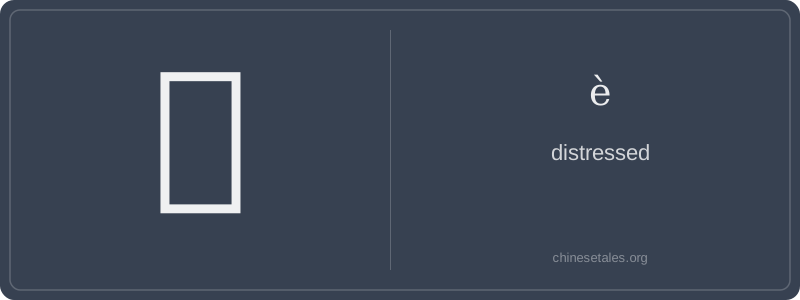
The earliest form of 厄 appears in bronze inscriptions as a simple yet vivid pictograph: a horizontal line (一) representing a low, oppressive cliff or overhang, with a vertical stroke (丨) beneath it — symbolizing a person squeezed beneath it, unable to stand upright. Over time, the ‘person’ simplified into a short diagonal stroke (丿), while the ‘cliff’ evolved into the radical 厂 (a bent line suggesting a sheltering but confining rock face). By the seal script era, the four-stroke structure was fixed: 厂 + 丶 (dot) + 丿 + 一 — each stroke reinforcing confinement: overhead limit, downward pressure, slanting obstruction, and final grounding barrier.
This visual logic directly shaped its meaning: from literal physical entrapment to metaphorical existential peril. In the *Zuo Zhuan*, 厄 describes a ruler trapped by political circumstance; in Tang poetry, it evokes spiritual crisis — ‘a mind in厄’ meaning ‘cornered by doubt’. Even today, its shape whispers compression: look at it sideways — it’s a person hunched under a low roof. That image never faded; it just grew quieter, folding into compound words rather than shouting alone.
厄 (è) isn’t just ‘distressed’ — it’s the quiet, heavy sigh before the storm. In Chinese, it evokes a sense of *inescapable constraint*: not mere sadness or inconvenience, but a fated, structural hardship — like being trapped under a low cave ceiling (its radical 厂 literally means ‘cliff’ or ‘overhanging rock’). It carries classical gravity; you won’t hear it in casual chat, but you’ll find it in phrases like 厄运 (è yùn, ‘ill fate’) or 噩耗 (è hào, ‘dire news’), where it intensifies misfortune with solemn inevitability.
Grammatically, 厄 almost never stands alone as a verb or adjective in modern speech — it’s strictly a literary morpheme, always embedded in two-character compounds. Learners sometimes try to say *‘wǒ hěn è’* (‘I’m very distressed’), but that’s unnatural and ungrammatical: 厄 doesn’t function like 苦 (bitter) or 难 (difficult). Instead, it pairs tightly with nouns (运, 运气, 灾) or abstract concepts (耗, 境) to form weighty, almost ritualized expressions of calamity.
Culturally, 厄 reflects a deep-rooted Chinese awareness of cosmic pressure — the idea that hardship isn’t random, but part of a larger, often inscrutable, pattern of fortune and misfortune. Confucian texts use it to describe moral peril (e.g., ‘the danger of losing one’s way’), while Daoist writings evoke physical entrapment — a narrow pass, a blocked path. A common learner mistake is overusing it thinking it’s ‘stronger than’ 苦 or 难; in truth, it’s *rarer*, more formal, and always contextualized — like using ‘doom’ instead of ‘trouble’ in English.