卽
Character Story & Explanation
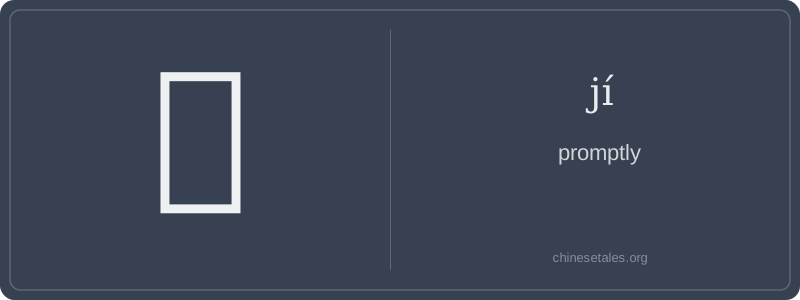
The earliest form of 卽 appears on Shang dynasty oracle bones as a pictograph showing a person kneeling beside food — specifically, a cooking vessel (the radical ⺼/⺗, later stylized as 卩) with rice grains (the top component, originally 口 + 皀). It depicted someone *about to eat* — the very instant before consumption, capturing poised readiness. Over centuries, the rice grains simplified into the top part 皀 (bī), while the kneeling figure (卩) became more angular; by the seal script era, the structure solidified into today’s 卽 — still evoking presence-at-the-moment-of-action.
This visual origin explains why 卽 always implies immediacy anchored in reality: not abstract 'soon', but *this precise juncture*. In the Classic of Poetry (Shījīng), 卽 appears in lines like '即見君子' (jí jiàn jūnzǐ) — 'Upon seeing the nobleman' — where 'upon' is the temporal hinge. The character never drifted into vague futurity; its meaning stayed tethered to the threshold between intention and action. Even today, in legal documents, 卽 signals the exact moment a clause takes effect — no ambiguity, no buffer zone.
Think of 卽 (jí) not as a dry 'promptly' but as the Chinese language’s little lightning bolt — it’s the snap of immediacy, the click of a switch flipping from 'soon' to 'now'. In classical and literary Chinese, it conveys urgency, inevitability, or logical consequence: 'as soon as X happens, Y follows'. It’s rarely used alone in modern speech — you’ll almost never hear someone say 'jí!' like 'Now!' — but it pulses through formal writing, legal texts, and idioms where precision and timing matter deeply.
Grammatically, 卽 often functions as an adverbial particle introducing a clause — think of it as 'right at the moment that...' or 'precisely when...'. For example, 卽令 (jí lìng) means 'even if', anchoring a hypothetical with razor-sharp timing. It can also mean 'namely' or 'that is to say' — a semantic pivot pointing directly to identity or equivalence. Learners sometimes misread it as 即 (its simplified form), but 卽 is the traditional variant used in Taiwan, Hong Kong, and classical texts — and confusing the two can make your essay look unintentionally archaic or regionally mismatched.
Culturally, 卽 carries the weight of Confucian punctuality and Daoist resonance — things unfolding *just so*, without delay or excess. A common mistake? Overusing it trying to sound 'formal', when native writers prefer context or verbs like 立刻 (lìkè) or 马上 (mǎshàng) for spoken urgency. 卽 isn’t about speed — it’s about *exactness of timing*, like a conductor’s downbeat.