卨
Character Story & Explanation
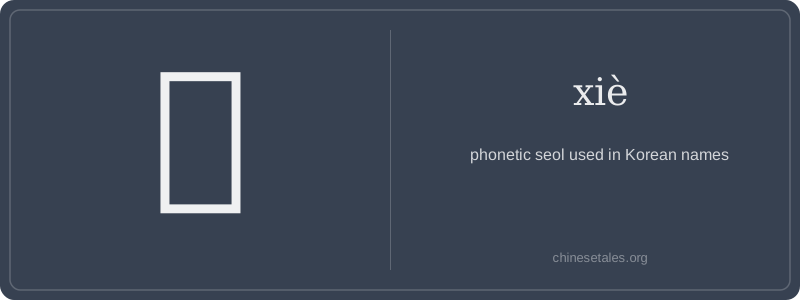
There is no oracle bone or bronze inscription for 卨 — because it didn’t exist before the Joseon Dynasty. It was deliberately constructed in the 1440s by Korean scholars working under King Sejong, who needed Hanja equivalents for Hangul syllables absent from classical Chinese vocabulary. They took the existing character 契 (qì, 'contract, seal'), removed its 口 (mouth) component, and replaced it with a simplified top — resulting in a new, non-Chinese glyph: 卨. Visually, it looks like 契 without its mouth — just the upper 'knife-and-axe' motif (the 㓞 element) sitting atop a bare horizontal base. No stroke count, no radical — just a clean, intentional void where meaning used to reside.
This wasn’t evolution — it was design. In classical Chinese, 契 referred to carved tally sticks used in agreements; 卨 inherited none of that semantic weight. Its sole purpose was phonetic fidelity to the Korean surname 'Seol', preserving aristocratic lineage records in official documents. Though occasionally cited in Ming-era Chinese diplomatic records listing Korean envoys, 卨 never entered literary or philosophical usage. Its form whispers silence — a character built not to convey, but to anchor sound across scripts.
Let’s be honest: 卨 is a linguistic ghost — it doesn’t *live* in modern Chinese. It has zero strokes (yes, really!), no radical, and isn’t in any standard dictionary or HSK list. That’s because 卨 isn’t a functional Chinese character at all — it’s a Korean-specific phonetic borrowing, created in the 15th century during the invention of Hangul to transcribe the Korean syllable 'seol' (like in the surname Seol/설). Think of it as a Chinese-character-shaped placeholder — like borrowing the letter 'X' to represent a sound in another language, even though 'X' means nothing in that context.
Grammatically, 卨 appears only in proper nouns — specifically, Korean names transliterated into Hanja. You’ll never see it in verbs, adjectives, or compounds in Chinese texts. Learners sometimes stumble by trying to parse it as if it had meaning or structure: 'What’s its radical? What’s its tone in Mandarin?' But here’s the twist — its pīnyīn 'xiè' is purely a later, scholarly *approximation* for reference; native speakers don’t pronounce it this way. It’s not used in speech, reading, or writing in Chinese — only in academic glossaries or historical linguistics footnotes.
Culturally, 卨 is a quiet testament to how Chinese characters were repurposed across East Asia. While Japan and Vietnam adapted Hanzi for their own languages, Korea uniquely invented Hangul *and then* retrofitted certain Hanja (like 卨) for rare name transcription — a hybrid act of linguistic sovereignty and scholarly convention. The biggest mistake? Assuming it’s 'used' — it’s archived, not active. If you see it, you’re reading a footnote, not a sentence.