卝
Character Story & Explanation
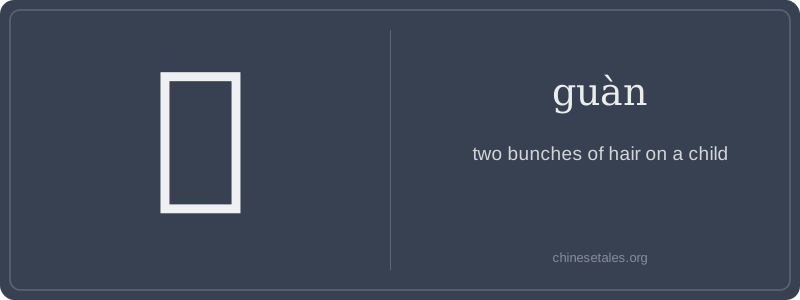
The earliest form of 卝 appears in oracle bone inscriptions (c. 1200 BCE) as two mirrored, angular ‘X’ shapes stacked vertically — each representing a bound cluster of hair, drawn with sharp, deliberate strokes mimicking tied locks. Over centuries, the upper and lower ‘X’s simplified: diagonal strokes shortened, corners squared, and the whole character condensed into its current compact, symmetrical form — still unmistakably dual and top-heavy, like two small horns or ribbons flaring from a child’s crown.
This visual symmetry wasn’t decorative — it reflected ritual precision. In the Rites of Zhou, boys aged seven to fifteen wore 卝-style hair as part of their ‘hair-parting ceremony’, signaling entry into formal education and moral training. Later, during Han commentary, scholars like Zheng Xuan explicitly glossed 卝 as ‘two tufts of hair on the temples of a young boy’. Its meaning never broadened — unlike similar-looking characters, 卝 stayed fiercely specific: not just ‘hair’, but *ritual childhood hair*, making it one of Chinese writing’s most narrowly defined pictographs.
Imagine a child in Shang dynasty ritual robes — not with neat pigtails, but two distinct, symmetrical tufts of hair tied high on either side of the forehead. That’s exactly what 卝 was: a stylized pictograph of those twin hair bunches, drawn as two X-like shapes stacked vertically (like × over ×). It’s not abstract calligraphy — it’s ancient portraiture in ink. Pronounced guàn, it evokes innocence, youth, and ceremonial purity — think of a boy entering adolescence in Zhou rites, his hair arranged just so before ancestral worship.
Grammatically, 卝 is nearly extinct in modern speech — you won’t hear it in conversation or see it in newspapers. It survives only in classical texts, poetic diction, or as a rare component in compound characters (like the ancient variant of 冠 ‘to crown’). Learners rarely *use* it, but they *encounter* it in historical linguistics, oracle bone studies, or when deciphering bronze inscriptions. A common mistake? Assuming it’s a variant of 十 or 乂 — but those are numerals or verbs; 卝 is purely a visual noun for hairstyle, frozen in time like a fossilized gesture.
Culturally, 卝 is a quiet witness to early Chinese body symbolism: hair arrangement marked life stages — infancy (shaved), childhood (tufts), adulthood (topknot). Its alternate reading kuàng appears only in obscure phonetic loan usages (e.g., in ancient rhyming dictionaries), never in semantic contexts. So while it looks simple — four strokes forming two crosses — it carries the weight of ritual identity, not arithmetic or action.