匽
Character Story & Explanation
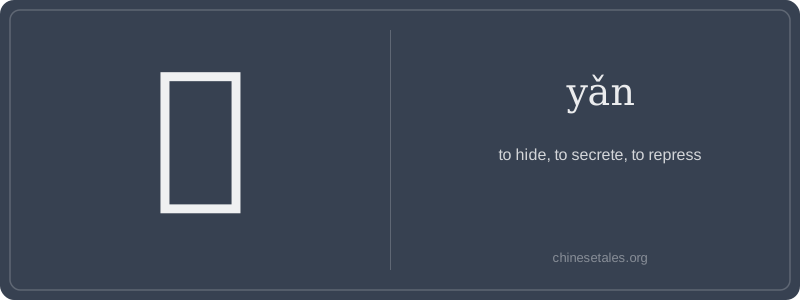
Carve this into your mind: 匽 began as an oracle bone script (c. 1200 BCE) pictograph — a simple yet potent image of a person crouching inside a sheltered enclosure (the radical 匸, pronounced xì, meaning ‘hiding place’ or ‘covered space’), with the right side evolving from a stylized human figure (亻) plus a downward stroke suggesting containment or inward motion. Over centuries, the crouching figure condensed into the component 奄 (yǎn), which itself meant ‘to cover over’ or ‘to collapse upon’, reinforcing the idea of envelopment. By the seal script era, 匽 had stabilized into its current 9-stroke form: 匸 (enclosure) + 奄 (covering/collapse), visually echoing a person vanishing into shadow.
This visual logic drove its semantic evolution. In the *Zuo Zhuan* (c. 4th century BCE), 匽 appears describing how a minister ‘yǎn qí guāng’ — ‘hid his brilliance’ — to avoid jealousy, linking concealment with political survival. Later, in Han dynasty medical texts like the *Huangdi Neijing*, 匽 described physiological secretion (e.g., sweat, urine) — not as expulsion, but as controlled release *from within*. The character never lost its sense of interiority: what is hidden or secreted originates deep inside and emerges only under constraint or necessity — a nuance lost on superficial readings.
Let’s get intimate with 匽 (yǎn) — a quiet, almost ghostly character that whispers 'conceal' rather than shouts it. Its core meaning isn’t flashy hiding like 捉迷藏 (hide-and-seek), but subtle, intentional suppression: repressing emotions (e.g., grief, anger), secreting bodily fluids, or withholding information. Think of it as the linguistic equivalent of holding your breath or biting your tongue — internal, deliberate, often with psychological or physiological weight.
Grammatically, 匽 is almost never used alone in modern Mandarin; it appears exclusively within compound words or classical/formal contexts. You won’t say *‘wǒ yǎn le tā’* — that’s ungrammatical. Instead, it surfaces in literary compounds like 匽溺 (yǎn nì, ‘to suppress and drown [emotions]’) or medical terms like 匽尿 (yǎn niào, archaic for ‘urinate’ — literally ‘secrete urine’). It’s a fossilized verb root, not a living standalone verb — a crucial distinction learners miss when overextending its usage.
Culturally, 匽 carries a faint Daoist or pre-Qin resonance: concealment as preservation or self-protection, not deception. Confucian texts occasionally use it to describe restraining improper desires (e.g., ‘yǎn qí xīn yù’ — suppress one’s lustful thoughts). Modern learners often misread it as 蔽 (bì, ‘to cover’) or confuse it with 演 (yǎn, ‘to perform’) due to sound-alike pinyin — but 匽 has zero theatricality. It’s not performance; it’s withdrawal. And yes — it’s absent from HSK for good reason: it’s elegant, precise, and nearly extinct outside specialized domains.