匣
Character Story & Explanation
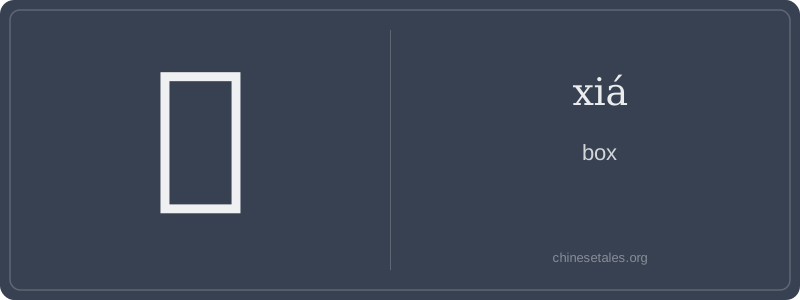
The earliest form of 匣 appears in bronze inscriptions as a simple pictograph: a rectangular frame (the ancestor of 匚) enclosing a small, centered stroke or dot — representing an object securely held within. Over centuries, the outer frame evolved into the clean, right-angled 匚 radical (a 'box radical' seen in other enclosure characters like 区 qū and 匹 pǐ), while the inner element solidified into 甲 (jiǎ), originally meaning 'armor' or 'shell', symbolizing protective hardness. By the seal script era, the two parts fused visually: 匚 + 甲 became 匣 — literally 'enclosure + armor', a visual metaphor for a fortified container.
This fusion wasn’t arbitrary. In ancient China, important items — ritual bronzes, bamboo slips, jade seals — were stored in lacquered wooden boxes reinforced with metal fittings or lined with leather. The character 匣 captured that ideal: not just containment, but *armored custody*. Classical texts like the Rites of Zhou mention ‘玉匣’ (yù xiá — jade box) for sacred objects, and Tang poets wrote of ‘琴匣’ (qín xiá — zither box) as silent witnesses to scholarly solitude. Even today, when a calligrapher opens a 匣 to reveal a Song-dynasty brush, the character whispers continuity — 2,500 years of reverence, sealed inside seven strokes.
Think of 匣 (xiá) not as just any box, but a *refined, enclosed container* — often wooden, ornate, and purpose-built for safeguarding precious things: scrolls, seals, musical instruments, or even medicinal herbs. Its core vibe is 'elegant containment' — never casual or disposable like a cardboard box (盒 hē). You’ll rarely hear it in daily speech (hence its absence from HSK), but it’s deeply embedded in literary, historical, and artistic contexts: a scroll tucked into a lacquered 匣, an ancient seal kept in a silk-lined 匣, or a guqin stored in its protective 匣.
Grammatically, 匣 functions almost exclusively as a noun — no verb forms, no adjectival use. It’s usually preceded by descriptive modifiers (e.g., 紫檀匣 zǐtán xiá — rosewood box; 锦缎匣 jǐnduàn xiá — brocade-lined box) and rarely stands alone. Learners sometimes mistakenly use it where 盒 (hē) or 箱 (xiāng) would be natural — but saying ‘我买了个匣’ sounds archaic or oddly poetic, like saying 'I bought a casket' instead of 'a box'. It pairs with verbs like 放入 (fàng rù — to place into), 取出 (qǔ chū — to take out), or 藏于 (cáng yú — to be hidden in).
Culturally, 匣 evokes classical Chinese aesthetics: restraint, reverence for objects, and the idea that protection enhances value. In Ming/Qing literature, characters open a 匣 to reveal fate-altering documents or heirlooms — the act itself carries weight. A common slip? Misreading the radical 匚 (fāng) as the more common 口 (kǒu) — but 匚 is a *hollow enclosure*, not a mouth! This subtle shape tells you: this isn’t about speaking or eating — it’s about holding, sheltering, and preserving.