匉
Character Story & Explanation
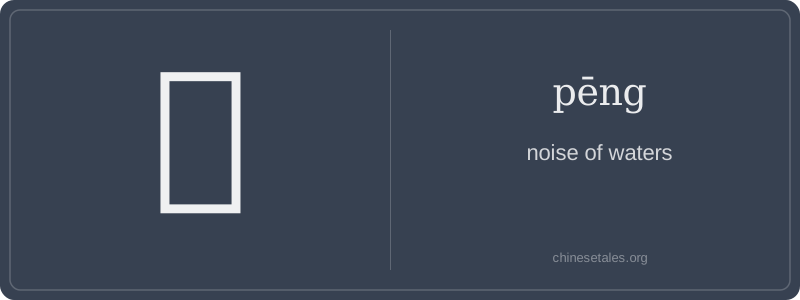
The earliest form of 匉 appears in bronze inscriptions as a vivid compound: on the left, a variant of 水 (shuǐ, water), drawn with three wavy lines; on the right, a phonetic component resembling 並 (bìng, 'together'), which later simplified into 並’s top two strokes plus a downward stroke — evolving into today’s 口 (kǒu, mouth) + 并 (bìng) shape. But here’s the twist: the ‘mouth’ wasn’t literal — it represented the *opening* or *outburst*, while the parallel strokes evoked rushing, converging currents. Over centuries, the water radical shifted position and stylized, and the right side condensed into the modern 并+口 structure — visually echoing water surging through a narrow channel.
This visual logic directly shaped its meaning: not just ‘water noise’, but the *sudden, resonant release* of pent-up energy — like floodgates opening. Classical texts like the Shuōwén Jiězì (121 CE) define it as ‘the sound of water striking stone’, linking it to geomorphic drama. In Tang poetry, poets used 匉訇 to describe mountain torrents echoing in deep valleys — turning hydrology into acoustic architecture. Even today, its shape whispers motion, pressure, and rupture — a perfect fusion of sound, force, and flow.
Think of 匉 not as a word you’ll use daily, but as a sonic brushstroke — a character that doesn’t describe water, but *recreates its roar*. Its core meaning — 'noise of waters' — is onomatopoeic and visceral: imagine crashing waves, a thundering waterfall, or a river bursting its banks. It’s not abstract; it’s auditory texture made visible. In classical and literary Chinese, 匉 almost always appears reduplicated (as 匉訇 or 匉然) to amplify impact — like English ‘boom!’ or ‘crash!’, but with hydraulic weight.
Grammatically, it functions as an adverbial modifier (often before verbs) or as part of fixed literary expressions. You won’t say ‘the river pēngs’ — instead, it’s 匉訇一声 (pēng hōng yī shēng, 'with a loud crash') or 匉然作响 (pēng rán zuò xiǎng, 'suddenly resounding'). Learners mistakenly treat it like a verb or try to use it alone — but 匉 never stands solo in natural usage. It’s a team player: it needs a partner sound (hōng, rán) or a context of sudden force.
Culturally, 匉 belongs to the elegant arsenal of classical onomatopoeia — favored in poetry and historical narratives to evoke awe, chaos, or divine intervention. Modern Mandarin rarely uses it outside set phrases or stylistic writing (e.g., travel essays about mountain gorges). A common pitfall? Confusing its sharp, explosive ‘pēng’ with softer sounds like ‘bāng’ or ‘pāi’. Remember: this isn’t a gentle splash — it’s nature shouting.