剋
Character Story & Explanation
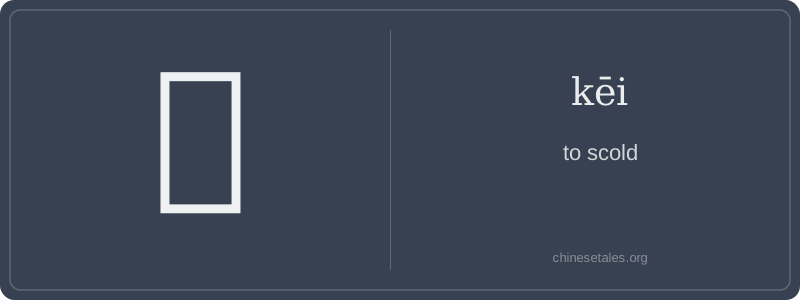
The earliest trace of 剋 appears not in oracle bones, but in late Ming vernacular manuscripts — a brilliant case of folk etymology in action. Scribes needed a character for the rising Beijing slang verb kēi (to scold), so they borrowed the shape of 克 (kè, 'to overcome'), then added the 刂 (knife) radical to intensify its sharpness — literally turning ‘overcome’ into ‘cut down verbally’. Visually, it’s 克 + 刂: nine strokes total, with the knife radical anchoring the right side like an exclamation point at the end of a shout.
By the Qing dynasty, 剋 was entrenched in storytellers’ scripts and opera libretti as the go-to word for fiery, rapid-fire scolding — especially in comedic roles like the irascible shopkeeper or the no-nonsense auntie. Classical texts never used it; Confucian decorum favored restrained terms like 责 (zé) or 训 (xùn). But 剋 thrived precisely *because* it broke decorum: its visual violence mirrored its vocal force. Even today, its shape whispers ‘knife’, its sound hisses ‘kēi’, and its usage still carries that same delicious, slightly dangerous thrill of speaking your mind — loudly.
Imagine a sharp, stinging reprimand — not just words, but verbal 'cuts' that leave a mark. That’s the visceral feel of 剋 (kēi): to scold sharply, often with impatience or exasperation. It’s not formal rebuke (like 批评) nor gentle correction (like 提醒); it’s the mom yelling ‘KĒI! Don’t touch that!’ or the boss snapping ‘KĒI! Where’s the report?’ — abrupt, loud, and emotionally charged. Grammatically, it’s almost always used as a verb in colloquial speech, usually in the reduplicated form 剋剀 (kēi kēi) for extra emphasis, and rarely appears in written formal contexts.
This character is strictly informal — you’ll hear it in Beijing hutongs, Shanghainese teahouses, or family group chats, but never in official notices or academic papers. Learners often mistakenly use it like English ‘scold’ in neutral contexts (e.g., ‘The teacher 剋ed the student’), but that sounds jarringly rude unless the tone is clearly playful or intimate. Also, it’s never used with polite honorifics: saying 您被剋了 would be hilariously inappropriate — it’s inherently unpolite, like shouting ‘Hey!’ instead of ‘Excuse me.’
Culturally, 剋 carries working-class grit — think street vendors haggling, taxi drivers venting, or grandparents teasing kids. Its sound (kēi) even mimics a sharp exhale — like a verbal ‘pfft!’ — and its 刂 (knife) radical isn’t metaphorical: it *feels* like being nicked by words. Unlike literary scolding terms, 剋 is oral, immediate, and unfiltered — a linguistic slapstick punchline with teeth.