刡
Character Story & Explanation
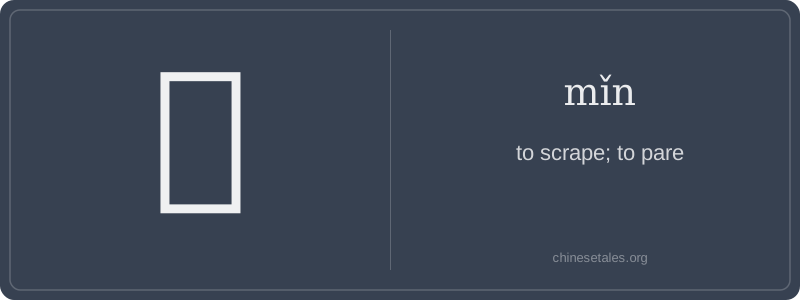
The earliest form of 刡 appears on Warring States bamboo slips as a compound glyph: left side was 刂 (the ‘knife’ radical, later standardized as 刂), and right side depicted two parallel horizontal strokes — representing thin, even layers — with a short vertical stroke cutting across them, like a blade slicing cleanly through laminated material. Over centuries, the right-hand component simplified: the double horizontals fused into one long stroke, and the crossing stroke evolved into the distinctive diagonal hook (㇀) seen today — a visual echo of the knife’s decisive, gliding motion.
This character thrived in pre-Qin technical texts and Han dynasty craft manuals, where it described the final, exacting stage of polishing bronze mirrors or preparing lacquerware substrates. In the *Rites of Zhou*, 刡 appears in the phrase ‘刡金以成其光’ (‘scrape gold to bring forth its luster’), linking physical removal to aesthetic revelation. Its shape never lost that sense of controlled incision — the hook isn’t decorative; it’s the moment the blade lifts, having removed just enough.
Here’s the truth no textbook tells you: 刡 (mǐn) isn’t just ‘to scrape’ — it’s the *precision* of removal. Think scalpels, not shovels. Its core feeling is controlled, fine-scale ablation: shaving off thin layers, erasing imperfections, or refining surfaces down to bare essence. In classical usage, it often appeared in metallurgical or craft contexts — describing how a master swordsmith would 刡 away oxidation from a blade’s edge, or how a jade carver would 刡 off microscopic burrs. You won’t hear it in casual speech today; it’s literary, technical, or poetic — like finding a chisel in a box of spoons.
Grammatically, 刡 is almost always a transitive verb and requires a direct object — you *must* say what’s being scraped. It rarely stands alone. Unlike common verbs like 刮 (guā), which implies rough, broad scraping (e.g.,刮胡子 ‘shave facial hair’), 刡 carries an air of intentionality and delicacy. Learners sometimes mistakenly use it for everyday actions like peeling fruit — but that’s 削 (xiāo) or 剥 (bō). Try: ‘他用细砂纸刡去木纹上的浮灰’ — note how the object (浮灰 ‘surface dust’) and tool (细砂纸 ‘fine sandpaper’) reinforce its refined nuance.
Culturally, 刡 echoes China’s deep reverence for craftsmanship and refinement — the idea that true excellence lies not in adding, but in *subtracting with mastery*. A common error? Confusing it with 悯 (mǐn, ‘to pity’) — same sound, totally different world. Pronunciation alone won’t save you; this character lives in the realm of touch, texture, and tactile control — not emotion.