刖
Character Story & Explanation
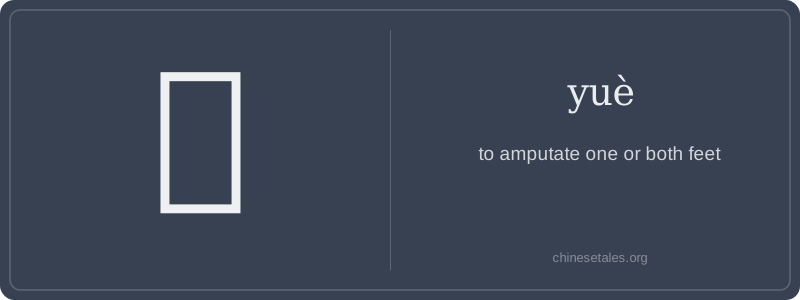
The earliest form of 刖 appears on late Shang bronze inscriptions as a composite glyph: a simplified foot (止, zhǐ) placed beside a knife (刀, dāo), later stylized into 刂. Oracle bone script shows a bare foot with three toes clearly drawn beneath a sharp blade — a stark, unambiguous pictograph of execution-by-amputation. Over centuries, the foot component condensed into the top-left 丿 + 一 shape (a stylized ‘foot stump’), while the knife evolved from 刀 to the standard right-side radical 刂 — yielding the clean, six-stroke modern form: 丿一丨刂.
This character’s meaning remained chillingly stable across 3,000 years. It appears in the *Book of Documents* (Shàngshū) describing punishments under Yu the Great, and is codified in the Qin bamboo slips unearthed at Shuihudi — where 刖刑 (yuè xíng) was listed alongside tattooing and castration as one of the ‘five corporal punishments’. Interestingly, its visual economy mirrors its function: just six strokes create a complete, irreversible act — no flourish, no ambiguity, no recovery. Even the stroke order enacts the logic: first the descending slash (the blade’s descent), then the horizontal (the severed line), then the knife radical — a sequence that feels like a legal decree being written, then enforced.
Think of 刖 (yuè) as China’s ancient equivalent of the ‘scarlet letter’ — not a symbol of shame worn on the chest, but a brutal, irreversible physical mark imposed by law. Unlike modern legal penalties, 刖 wasn’t about imprisonment or fines; it was a deliberate, ritualized removal of the feet — a punishment so severe it rendered victims socially invisible, economically crippled, and ritually impure. The character carries visceral weight: it’s never used lightly, never in metaphorical or softened contexts like ‘cutting corners’ — it means *literal, state-sanctioned amputation*.
Grammatically, 刖 is almost exclusively a verb, and only appears in classical or historical registers — you’ll never hear it in daily conversation or see it on a menu. It takes no aspect particles (no 了, 过, or 着) in classical usage and rarely appears with objects unless specifying whose feet (e.g., 刖其足). Modern writers use it only in scholarly or literary allusions — for instance, describing Qin dynasty legal cruelty: ‘秦律严苛,常刖人足’ (Qín lǜ yánkē, cháng yuè rén zú). Using it like a regular verb (e.g., 我刖了他) would sound grotesquely anachronistic and grammatically jarring to native ears.
Learners often misread 刖 as a variant of 月 (yuè, ‘moon’) or confuse it with 岳 (yuè, ‘mountain peak’) due to similar pronunciation — but those characters evoke harmony or majesty, while 刖 evokes silence, limping absence, and institutional violence. A common trap is overgeneralizing its meaning to ‘to cut’ or ‘to punish’ — but 刖 is *only* about feet, and *only* in pre-Qin to Han legal-historical discourse. Its rarity today makes it a linguistic fossil — fascinating, precise, and utterly unforgiving.