刎
Character Story & Explanation
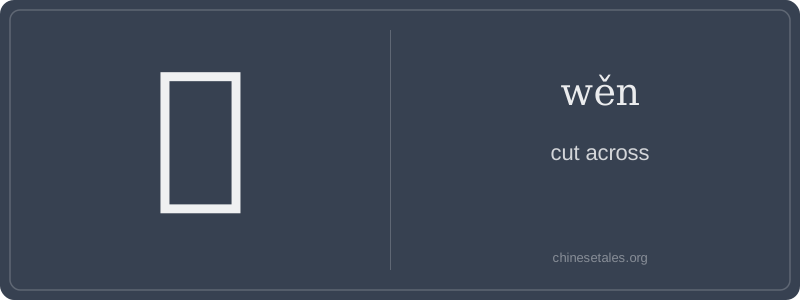
The earliest form of 刎 appears in Warring States bamboo slips—not oracle bones—as a phono-semantic compound: the left side 歄 (a variant of wěn, now obsolete) provided sound, while the right-side 刂 (knife radical) signaled meaning. Visually, it evolved from a more complex seal-script form where the left component resembled a mouth + phonetic element, gradually simplifying into today’s clean six-stroke structure: 丿一丨丨. The stroke order—starting with the falling slash (丿), then horizontal (一), vertical (丨), turning hook (), and finishing with the knife’s blade (丨)—mirrors the motion of drawing a blade *across* a surface: swift, deliberate, and terminal.
This character’s meaning crystallized around the Zhou–Qin transition, when ritualized self-sacrifice and warrior codes demanded precise vocabulary for fatal acts. In Sima Qian’s *Records of the Grand Historian*, 刎 appears in descriptions of loyal retainers who 'cut across the neck' (刎颈) to uphold honor—making the physical act symbolic of absolute commitment. The visual economy of its six strokes—just enough to evoke both sound and violence—reflects how Classical Chinese prized semantic density: every line must carry lethal intent.
Think of 刎 (wěn) as the Chinese equivalent of a surgical scalpel’s decisive, transverse cut—not hacking or slashing, but a clean, precise cross-section. Its core meaning 'cut across' evokes anatomical precision: imagine a surgeon’s incision perpendicular to a limb’s axis, or a river cutting *across* a valley—not flowing along it. Unlike common verbs like qiē (切, 'to cut' generally) or gē (割, 'to sever'), 刎 is literary, formal, and almost exclusively used in compound words or classical contexts; you’ll rarely hear it alone in speech.
Grammatically, 刎 never stands solo as a verb in modern Mandarin—it’s strictly bound within compounds like 刎颈 (wěn jǐng, 'cut the neck') or 刎杀 (wěn shā, 'slay by cutting'). It functions as a monosyllabic morpheme with strong semantic weight: always implying intentional, often violent, transverse action—never accidental or gentle. Learners mistakenly try to use it like 切 (e.g., *wǒ wěn le yí gè píngguǒ*), but that’s ungrammatical and jarringly archaic. Instead, it appears only where literary gravity or historical allusion is intended—like describing ancient duels or poetic metaphors for irreversible rupture.
Culturally, 刎 carries the solemn weight of loyalty and finality—most famously in the idiom 刎颈之交 (wěn jǐng zhī jiāo), 'a friendship so deep one would cut one’s neck for the other'. Misusing it as a casual verb betrays ignorance of its ritualized, life-or-death connotation. Also, beware tone confusion: wěn (third tone) sounds like wēn (warm) or wèn (ask), but shares no semantic kinship—its sharpness lives entirely in the 刂 radical and its violent lineage.