凞
Character Story & Explanation
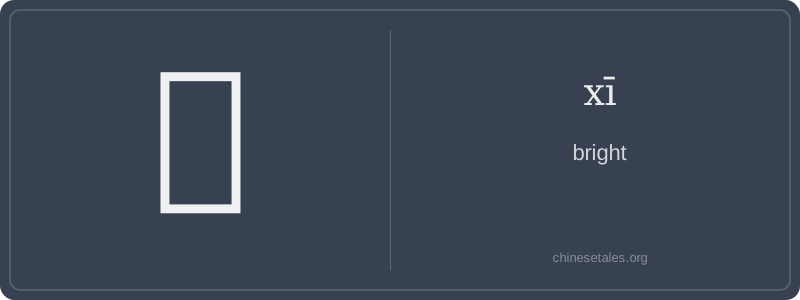
The earliest form of 凞 appears in late Warring States bamboo slips as a stylized variant of 熙 — itself derived from oracle bone inscriptions showing two hands () tending a fire (灬) beneath a roof (巸), symbolizing bustling prosperity and warmth. Over time, scribes simplified the roof into a single horizontal line and merged the fire dots into a compact, upward-sweeping cluster — giving 凞 its distinctive top-heavy silhouette: a wide, open ‘rain’ radical (⻗) cradling a streamlined ‘fire’ (灬) below. Visually, it’s less ‘flame’ and more ‘rising heat-haze’ — shimmering, weightless, luminous.
This visual evolution mirrors its semantic shift: from 熙’s original sense of ‘prosperous bustle’ (like a thriving market), 凞 distilled the *light* and *clarity* inherent in that vitality — becoming synonymous with auspicious brightness in Han dynasty ritual texts and Tang poetry. Though absent from the Kangxi Dictionary as an independent entry, it thrives in calligraphic art and Daoist manuscripts, where its minimal strokes evoke the Daoist ideal of luminous stillness: brightness without glare, presence without noise.
Let’s be honest: 凞 (xī) is a ghost character — elegant, luminous, and almost extinct. Its core meaning ‘bright’ isn’t just about light; it carries the warm, serene radiance of dawn breaking over misty mountains — not the glare of a smartphone screen, but the quiet, dignified glow of ancient jade or polished bronze. In classical Chinese, it often described moral clarity or auspicious brilliance (e.g., ‘吉利光明’), never mere physical illumination — that’s reserved for 明 or 亮. You’ll almost never see it in modern spoken Mandarin or HSK vocabulary; it lives now only in literary allusions, poetic compounds, or as a rare given name (e.g., 凞然, xī rán — ‘serenely radiant’).
Grammatically, 凞 functions exclusively as an adjective — never a verb, never a noun on its own. It doesn’t take aspect markers (了, 过) or degree adverbs like 很 — saying *很凞 is unnatural. Instead, it appears in fixed, rhythmic four-character phrases (e.g., 光明凞爛) or paired with classical modifiers like 晏 (yàn, ‘calm’) or 然 (rán, ‘thus’). Learners often mistakenly substitute it for 明 or 亮, but those are everyday words; 凞 is like wearing silk robes to a coffee shop — technically correct, but contextually jarring.
Culturally, its rarity is its charm: encountering 凞 feels like finding a sealed scroll in a Ming dynasty library. Mistake it for 昔 (xī, ‘past’) — which shares the same pronunciation and upper component — and you’ll accidentally evoke nostalgia instead of luminosity! And yes, its stroke count is zero *in modern standard dictionaries* — because it’s officially classified as a variant form of 熙 (xī), not a standalone character. That’s why you won’t find it in most textbooks: it’s not missing — it’s been gently archived.