幂
Character Story & Explanation
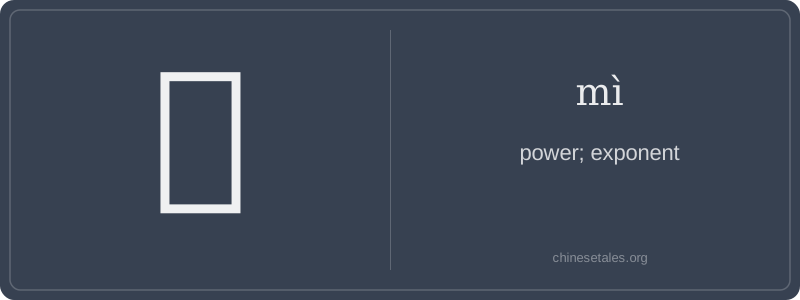
The earliest form of 幂 appears in Han dynasty bamboo slips as a compound: 冖 (a downward stroke representing a covering cloth) atop 帛 (bó, 'silk fabric'), later simplified. Over centuries, 帛 eroded — its left 'silk' radical (巾) shrank into 米 (mǐ, 'rice'), while the right phonetic component vanished. By the Tang, the character stabilized as 冖 + 米: 12 strokes total — two dots (丶丶) for rice grains, a horizontal line (一), then the 'rice' structure (米) nested under the 'cover' radical (冖). Visually, it’s a cloth draped over grain — a perfect image of concealment and layering.
This textile origin directly shaped its meaning: in the 3rd-century mathematical classic 《九章算术》(The Nine Chapters on the Mathematical Art), 幂 originally meant 'area' — specifically, the *covered surface* of a field, like cloth spread over land. Only during the Song-Yuan mathematical renaissance did scholars like Qin Jiushao extend it to exponents, reasoning that raising to a power 'covers' the base with repeated multiplication — each exponent adding another 'layer' of operation. The character didn’t change shape; its conceptual fabric simply expanded.
At first glance, 幂 (mì) feels like a quiet, technical ghost — it’s almost never heard in daily conversation, yet it haunts every high-school math textbook and university physics lecture. In Chinese, 幂 doesn’t just mean 'power' or 'exponent' — it carries the subtle weight of *repeated multiplication as layered covering*, echoing its ancient root meaning: 'to cover with cloth'. That visual metaphor is deeply Chinese: abstraction isn’t detached logic here; it’s grounded in tangible, embodied experience — like draping fabric over something to conceal, protect, or transform it. So when you say 2的三次幂 (èr de sān cì mì), you’re not just computing 2³ — you’re invoking an act of *layered veiling*, where each exponent adds another fold.
Grammatically, 幂 only appears in formal, written mathematical contexts — never alone, always as part of compounds like 次幂 (cì mì, 'power') or 平方幂 (píngfāng mì, 'square power'). You’ll never hear someone say 'mì!' in class — it’s always preceded by a number and classifier (e.g., 五次幂). Learners often misread it as mì (correct) but then wrongly assume it’s interchangeable with 次 (cì, 'times') or 方 (fāng, 'square/cube'); it’s not — 幂 is strictly the *noun* for the exponent itself, while 方 is the *verb/noun* for squaring/cubing operations.
Culturally, 幂 reveals how Chinese mathematical language preserves ancient semantics: even abstract algebra leans on concrete, textile-based imagery. A common mistake? Confusing it with 密 (mì, 'dense/secret') — same sound, totally different world. And yes, it’s absent from HSK because Mandarin speakers rarely utter it aloud; they say 'x 的 n 次方' instead. So 幂 lives in ink, not speech — a silent guardian of mathematical precision.