僚
Character Story & Explanation
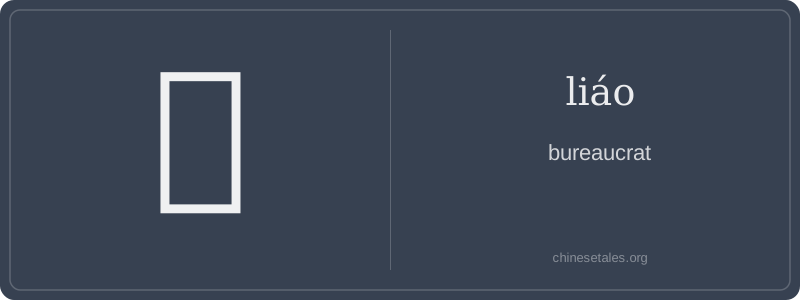
The earliest form of 僚 appears in Warring States bamboo slips, not oracle bones — and it’s a brilliant piece of semantic engineering. The left side is 亻 (rén bàng), the 'person' radical, anchoring it in human agency. The right side is 辽 (liáo), originally written as 辽 (a variant of 遼, meaning 'distant' or 'vast'), but here repurposed phonetically and semantically: in ancient administration, officials were often dispatched *to distant regions* to govern, supervise, or coordinate — their role defined by both geographic reach and delegated authority. Over centuries, the right component simplified from 辽 to 辽 (with simplified 辶 + 尞), and the whole character stabilized into today’s 14-stroke form: two dots above, then 尞’s distinctive 'fire-like' top (the two dots + 'x' shape), followed by the walking radical 辶 wrapping underneath.
This visual logic persisted: a person (亻) sent far afield (辽 → 辽) to carry out official duties — hence, 'assigned official'. Classical texts like the Zuo Zhuan use 僚 to distinguish trusted aides from hereditary nobles, emphasizing appointment over birthright. By the Tang dynasty, 僚 solidified as the term for subordinate civil servants — especially those serving under high-ranking ministers, like secretaries or attendants. Its form quietly tells a story of mobility, delegation, and bureaucratic expansion: not born to rule, but *sent* to serve — a detail etched in every stroke.
Think of 僚 (liáo) as the quiet, ink-stained cousin of 官 (guān, 'official') — not the top-tier mandarin with a jade tablet, but the diligent mid-level bureaucrat who drafts memorials, files documents, and keeps the imperial machinery humming. Its core meaning isn’t just 'bureaucrat' in a dry administrative sense; it carries subtle connotations of *subordinate official*, someone formally appointed to assist or serve within a hierarchy — often implying loyalty, procedural rigor, and institutional embeddedness. You’ll rarely hear it in casual speech; it lives in formal writing, historical texts, and modern political discourse where precision about rank matters.
Grammatically, 僚 functions almost exclusively as a noun, typically appearing in compounds (like 官僚 or 幕僚), never standalone in modern usage. It doesn’t take aspect particles (了, 过) or plural markers (们) — you wouldn’t say *僚们*; instead, you’d say *各位僚属* or *一批僚员*. Learners sometimes misread it as *liǎo* (like 了), but the tone is firmly second (liáo), rhyming with 'how' — a small slip that could derail pronunciation confidence.
Culturally, 僚 evokes the Confucian ideal of service through proper role: not power for its own sake, but authority earned through competence and fidelity to duty. A common pitfall? Overgeneralizing it as 'government worker' — that’s better rendered by 公务员 (gōngwùyuán). 僚 implies a specific *appointed, advisory, or administrative function within an established structure*, like a policy advisor in a ministry, not a municipal clerk. Its aura is scholarly, slightly archaic, and unmistakably hierarchical.