傿
Character Story & Explanation
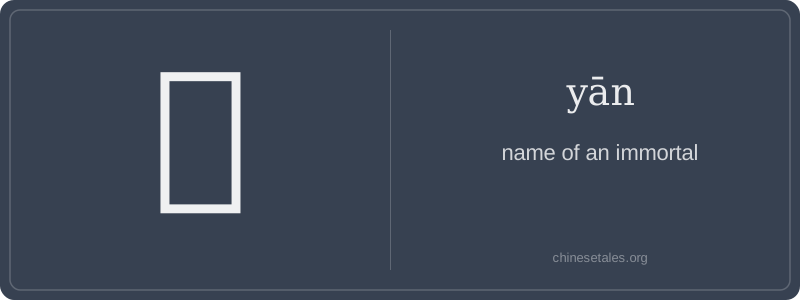
The earliest trace of 傿 appears not in oracle bones, but in Han dynasty clerical script — a deliberate creation, not an evolution from pictograph. Scribes combined 亻 (person) with the already-established character 焉 (yān), which itself began as a composite: the top 尸 (a seated figure) + the bottom 与 (a hand offering something). By Han times, 焉 had stylized into its familiar form — a visual shorthand for 'there' or 'where'. When paired with 亻, the new character 傿 emerged as a dedicated logograph for the immortal’s name, preserving both sound and the sense of 'a person who abides there — beyond ordinary realms'.
This naming strategy reflects Han dynasty cosmology: immortals weren’t abstract ideals but named individuals inhabiting specific sacred mountains. The Liexian Zhuan (Biographies of Immortals, c. 1st century BCE) mentions Yān as a reclusive adept on Mount Heng, famed for brewing dew-tea and conversing with cranes. Visually, the 13 strokes map neatly: 2 for 亻, 11 for 焉 — a balanced structure where the person radical anchors the celestial element, making the immortal feel both human and transcendent. No stroke is decorative; each contributes to identity and resonance.
First, let’s crack the code: 傿 is a rare, literary character — not for daily chat but for classical allusion and poetic naming. Its core meaning is 'Yān', the name of a legendary immortal from Daoist hagiographies, specifically one associated with longevity and mountain seclusion. Think of it as a proper noun frozen in ink — like 'Merlin' in English: you won’t conjugate it or pluralize it; it just *is*. The radical 亻 (person) signals it refers to a being — not a concept or object — while the right side 焉 (yān) serves double duty: it’s both the phonetic clue (giving the main pronunciation yān) and a classical particle meaning 'there' or 'thus', subtly reinforcing the immortal’s ethereal, 'otherworldly presence'.
Grammatically, 傿 functions almost exclusively as a proper noun in names — never as a verb, adjective, or standalone word. You’ll encounter it only in contexts like ancient texts, temple inscriptions, or modern poetic or artistic names (e.g., a calligrapher signing work as ‘Yān Shan’). Learners sometimes misread it as a common word — but there’s no such thing as 'to yān' or 'very yān'. It’s strictly a name, and using it outside that frame sounds jarringly archaic or nonsensical. Also beware: while yān is standard, yàn appears in rare historical variants (e.g., in some Song dynasty rhyme dictionaries), but this reading is obsolete and functionally irrelevant for modern learners.
Culturally, 傿 evokes the quiet majesty of Daoist immortals who dwell beyond time — not flashy deities, but serene sages perfected through cultivation. Mispronouncing it as yàn (like 艳) or confusing it with similar-looking characters (e.g., 焉 or 烟) risks turning a revered immortal into 'smoke' or 'beauty' — a delightful but embarrassing semantic slip! Its rarity means even many native speakers pause before reading it — so don’t feel discouraged; its obscurity is part of its charm.