偨
Character Story & Explanation
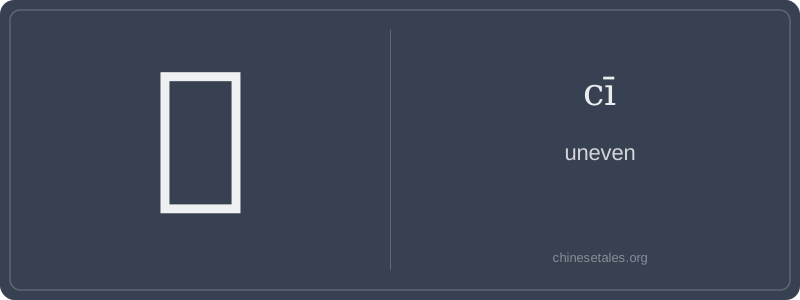
The earliest trace of 偨 appears not in oracle bones, but in Warring States bamboo slips and Han dynasty seals — and its form is strikingly pictographic. The left radical 亻 (person) anchors it, while the right side, now written as 次, originally depicted a person kneeling beside a series of irregular, staggered marks — possibly representing uneven terrain, broken steps, or mismatched teeth. Over centuries, the 'staggered marks' simplified into 次 (cì), which itself meant 'next' or 'order', subtly reinforcing the idea of disrupted sequence. By the late Han, the character stabilized into its current structure: 亻+次 — visually echoing a person confronting disorder.
This visual logic shaped its semantic journey. In the Shuōwén Jiězì (121 CE), Xu Shen defined 偨 as 'not level; irregular in height or arrangement', citing its use in describing jagged mountain ranges in the Chǔ Cí (Songs of Chu). Later, poets like Du Fu used 偨 in compound forms like 偨峐 (cī qǐ) — where 峐 means 'mountain ridge' — to conjure landscapes that feel dynamically unbalanced, alive with tension. Its endurance isn’t in frequency, but in precision: no other character so economically evokes *aesthetic unevenness* — not just physical flaw, but rhythmic disruption with artistic weight.
At first glance, 偨 (cī) feels like a linguistic ghost — it’s real, it’s in the dictionary, and it means 'uneven' or 'irregular', but you’ll almost never hear it spoken aloud in modern conversation. That’s because it’s a literary fossil: deeply rooted in classical Chinese, reserved for poetic, descriptive, or highly formal contexts (think ancient poetry or scholarly essays), not daily chat. Its core vibe is visual texture — not just physical bumps, but jagged rhythm, asymmetrical balance, or disrupted harmony. You won’t say 'the floor is 偨' — you’d use 不平 (bù píng) — but you *might* write 偨峐 to evoke the serrated silhouette of distant mountains at dusk.
Grammatically, 偨 is almost always an adjective, but unlike most adjectives, it rarely stands alone. It clings to other characters in fixed, often archaic compounds (like 偨牙 or 偨峐), and it never takes degree adverbs like 很 or 非常. Trying to say 'very uneven' as *很偨*? Native speakers will blink — it’s grammatically jarring, like saying 'very thither' in English. Instead, it functions as part of a compound noun or a tightly bound descriptive phrase, often modifying nouns directly without 的.
Culturally, 偨 carries a quiet elegance — it’s the kind of word that appears in Song dynasty landscape painting inscriptions or Tang poetry describing broken clouds or fractured ice. Learners’ biggest mistake? Assuming it’s interchangeable with common synonyms like 不平 or 凹凸. It’s not — it’s narrower, more aesthetic, and far more constrained. Using it casually risks sounding either comically archaic or unintentionally pretentious. Think of it less as a vocabulary item and more as a brushstroke in classical calligraphy: precise, intentional, and never used lightly.