俟
Character Story & Explanation
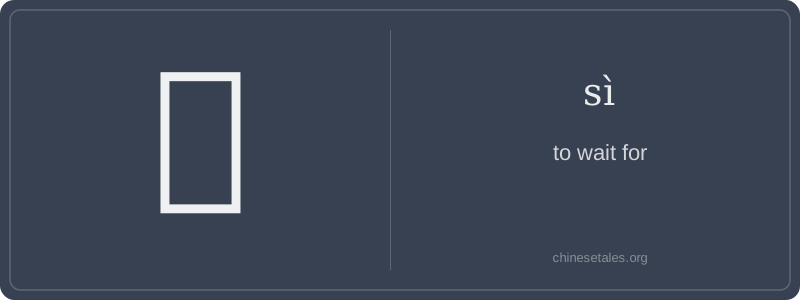
Carved on Shang dynasty oracle bones over 3,000 years ago, the earliest ancestor of 俟 wasn’t this character at all — it was a compound pictograph showing a person (亻) standing beside a stylized 'spider web' or 'net' (the ancient form of 㐁, later simplified to 巳), symbolizing entrapment or suspended motion. Over centuries, the net morphed into 巳 (a snake-shaped glyph representing cyclical stillness), while the person radical 亻 stayed anchored on the left — visually encoding 'a person held in suspended readiness'. By the Han dynasty clerical script, the shape stabilized: 亻 + 巳, nine strokes total, each line drawn with measured restraint.
This visual logic shaped its meaning: not passive waiting, but active, poised readiness — like an archer holding breath before release. In the Book of Rites, 俟 appears in ritual contexts: '君子俟命' (The noble person awaits his mandate), framing waiting as moral discipline. Even today, the 巳 component whispers of the snake — coiled, watchful, unhurried — reminding us that true waiting isn’t empty time, but focused potential. The character doesn’t just mean 'to wait'; it embodies the Chinese ideal of *shí* (timeliness): knowing precisely when to move — because you’ve been waiting *exactly right*.
At its heart, 俟 (sì) is the quiet, dignified verb for 'to wait for' — but not the casual 'wait a sec' kind. It’s the patient, almost ceremonial waiting you’d find in classical texts or formal writing: waiting for a sign, for justice, for destiny to unfold. Think of it as 'awaiting with intention', not just killing time. You’ll rarely hear it in spoken Mandarin (we’d use 等 instead), but it pulses with gravitas in essays, legal documents, and literary translations — like saying 'we await your decision' instead of 'we’re waiting for your reply'.
Grammatically, 俟 is a transitive verb that *requires* an object — you always wait *for something or someone*. It often appears in formal subordinate clauses introduced by 俟… then… (e.g., 俟会议开始后… — 'Upon the meeting’s commencement…'). Learners sometimes mistakenly use it like 等 without an object ('I will 俟'), or confuse its tone (sì, not sī or shì). And crucially: it never takes aspect particles like 了 or 过 — its form stays unchanged, reinforcing its timeless, deliberate feel.
Culturally, 俟 carries echoes of Confucian patience and ritual timing — waiting not out of passivity, but out of respect for proper order. That’s why it thrives in phrases like 俟机 (await the opportunity) or 俟命 (await one’s fate). A common trap? Using it in casual speech — your friend won’t say '我俟你' at the café; they’ll say '我等你'. Reserve 俟 for moments when the wait itself matters — when silence has weight, and anticipation is an act of virtue.