俎
Character Story & Explanation
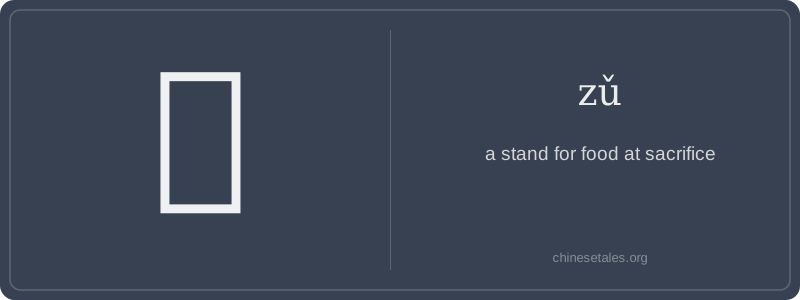
The earliest form of 俎 appears in Shang oracle bone inscriptions as a clear pictograph: two parallel horizontal lines (representing the wooden platform) crossed by a vertical line (the supporting leg), with small strokes jutting sideways — unmistakably a low, sturdily carved stand for ritual meat. Over centuries, bronze script added decorative elements, and seal script stylized the legs into angular strokes. By the Han clerical script, the top evolved into the shape we now recognize as 且, while the lower part simplified into the radical 人 — though historically, that ‘person’ is a visual ghost of the original leg-and-platform structure.
This humble stand became culturally monumental. In the Book of Rites (Lǐjì), 俎 appears over 200 times — always specifying which meats went on which 俎, for which ancestor, during which rite. Its symbolism deepened: in Mencius, the phrase '人为刀俎,我为鱼肉' (rén wéi dāo zǔ, wǒ wéi yú ròu) — 'Others are the knife and cutting board; I am the fish and flesh' — cemented 俎 as the ultimate image of helpless subjection. Visually, the character’s nine strokes echo the careful craftsmanship of the real object: three for the top slab (且), two for the legs, and four for stability — a silent tribute to ritual precision.
At its heart, 俎 (zǔ) is a ritual object — not just any tray, but a sacred wooden stand used in ancient Chinese ancestral sacrifices to hold meat offerings. Think of it as the altar’s serving platter: elevated, carved, and charged with solemnity. Its meaning is narrow and archaic; you’ll almost never hear it in daily speech — no one orders ‘zǔ’ at a restaurant — but it lives on powerfully in idioms and classical allusions, carrying the weight of reverence and hierarchy.
Grammatically, 俎 functions almost exclusively as a noun, often appearing in fixed expressions like 刀俎 (dāo zǔ, 'knife and cutting board') — where it symbolizes the passive, vulnerable position (the 'board' receiving the cut). You won’t say 'I put food on the zǔ'; instead, you’ll encounter it in literary or rhetorical contexts: 'He stood before the ancestors, offering wine and meat upon the 俎.' It never takes aspect markers (了, 过) or pluralizers (们), and using it conversationally would sound like quoting Confucius at a coffee shop — charming, but deeply out of place.
Culturally, 俎 is inseparable from the Zhou dynasty’s ritual system (li 礼). Mistaking it for a generic table (桌 zhuō) or plate (盘 pán) misses its spiritual gravity — this wasn’t furniture, it was a conduit between human and spirit. Learners sometimes misread its radical 人 (‘person’) as indicating human action, but here it’s actually a corrupted form of 且 (qiě), an ancient pictograph of a sacrificial tablet — a classic case where the modern radical tells only half the story. That’s why memorizing 俎 isn’t about utility — it’s about unlocking layers of classical thought.