侘
Character Story & Explanation
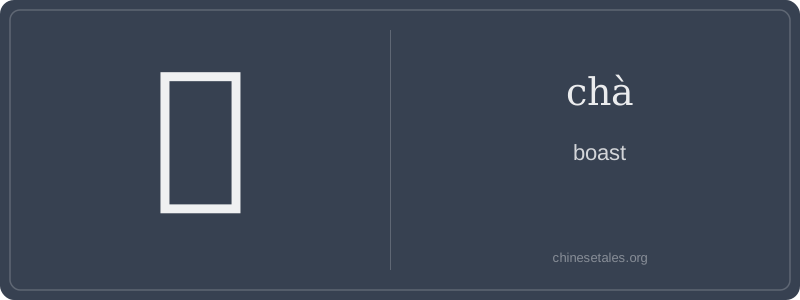
The earliest attested form of 侘 appears in Warring States bamboo slips, not oracle bones — and its structure reveals its story. The left side is 亻 (rénbàng), the 'person' radical, anchoring it to human action. The right side is 吾 (wú, 'I/me'), which itself evolved from a pictograph combining 'mouth' and 'standing person'. So visually, 侘 is 'a person speaking *I*', literally 'I-speak' — a compact glyph for self-referential utterance. Over centuries, 吾 simplified: the upper part (五 wǔ) lost its decorative strokes, and the lower 口 (kǒu, 'mouth') merged subtly with the body, yielding today’s sleek, asymmetrical shape.
This visual logic shaped its meaning: from 'I-speak' → 'I proclaim (myself)' → 'I vaunt my merits'. It appears in the Chu Ci (Songs of Chu), notably in Qu Yuan’s 'Li Sao', where the poet laments how flatterers '侘其能' ('boast of their talents') while true virtue goes unheeded. The character’s tight fusion of 'person' and 'I' makes it uniquely self-centered — no other Chinese character so economically encodes the act of ego-driven speech. Even its rare modern revivals (e.g., in literary essays) retain this aura of deliberate, almost defiant self-assertion.
Imagine a dusty, sun-baked marketplace in ancient Chu state, where a merchant slaps his chest and declares — not with quiet pride, but with theatrical swagger — that his lacquerware is 'the finest under heaven!' That’s 侘 (chà): not humble confidence, but *boastful* self-praise — loud, unapologetic, and often slightly ridiculous. It carries the flavor of someone puffing up their chest like a rooster, not just stating a fact. In classical texts, it appears almost exclusively as a verb meaning 'to boast' or 'to brag', rarely used alone today.
Grammatically, 侘 functions as a transitive verb — always followed by what’s being boasted about (e.g., 侘其富 'boasts of his wealth'). You won’t find it in modern spoken Mandarin; it’s literary, archaic, and almost exclusively confined to classical poetry, historical narratives, or stylistic allusions. Learners sometimes misread it as a synonym for 骄 (jiāo, 'arrogant') or 夸 (kuā, 'to praise'), but 侘 is sharper: it implies *performative self-aggrandizement*, not just arrogance or general praise — and crucially, it’s always *self*-directed, never used to praise others.
Culturally, 侘 resonates with Daoist and early Confucian critiques of vanity — think of Zhuangzi mocking those who 'swagger with ritual caps and jade pendants'. Its rarity today makes it a linguistic fossil: if you encounter it, you’re likely reading something deliberately archaic or ironic. Mistake it for 诧 (chà, 'to marvel') — an easy slip given identical pronunciation — and your sentence transforms from 'he boasts' into 'he marvels', flipping meaning entirely.