侔
Character Story & Explanation
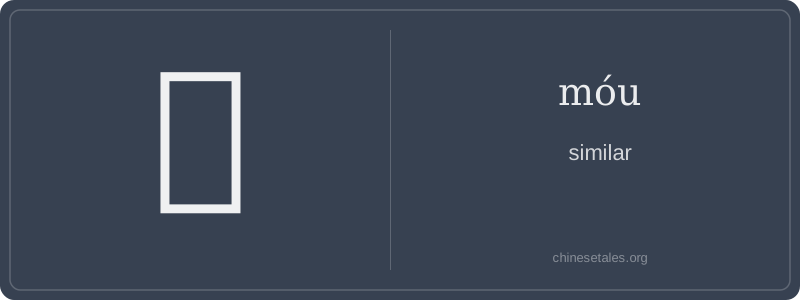
The earliest form of 侔 appears in Warring States bamboo slips — not as a pictograph, but as a phonosemantic compound. Its left side 亻 (rén bàng) signals 'human-related action', while the right side 谋 (móu) — originally depicting 'a mouth speaking over a plan' — was borrowed for sound *and* subtle semantic reinforcement: matching requires deliberation, intention, even strategy. Over centuries, the complex 谋 simplified to 丂 + 一 + 口, losing its full 'plan' imagery but keeping the resonant móu sound and the sense of conscious alignment.
By the Han dynasty, 侔 appeared in texts like the Hanshu (Book of Han) to describe officials whose virtue 'matched' ancient sages — no longer just 'looked alike', but carried equal moral authority. Its visual structure — a person (亻) beside a symbol of calculated speech (the simplified 谋) — quietly embodies its core idea: human equivalence forged through mindful, deliberate parity. In classical rhetoric, to say two things 侔 wasn’t observation — it was an act of judgment, assigning them shared stature in the cosmic or ethical order.
At its heart, 侔 (móu) isn’t just ‘similar’ — it’s *equivalent in weight, status, or merit*. Think less 'these apples look alike' and more 'this scholar’s wisdom rivals Confucius’s'. It carries a quiet, almost reverent gravity: used when comparing things that deserve equal respect — virtues, achievements, or cosmic forces. You’ll rarely hear it in casual speech; it lives in classical texts, formal essays, and literary criticism.
Grammatically, 侔 functions as a verb meaning 'to match', 'to rival', or 'to be on par with', almost always followed by a noun or clause introduced by 与 (yǔ) — 'with'. For example: '其才与颜回侔' (His talent rivals Yan Hui’s). Unlike adjectives like 相似 (xiāngsì), 侔 implies active parity, not passive resemblance — it’s a dynamic verb of equivalence. Learners often mistakenly use it as an adjective ('very 侔') or confuse it with mere visual similarity, missing its ethical and hierarchical resonance.
Culturally, 侔 reveals how deeply Chinese thought values calibrated comparison: not just 'same/different', but *measured equivalence* — where rank, virtue, and consequence matter. Classical writers used it to uphold standards: if your poetry doesn’t 侔 Du Fu, it falls short. A common mistake? Overusing it like English 'match' — but 侔 never means 'to match in skill level during a game'; that’s 比 (bǐ) or 打平 (dǎpíng). It’s reserved for moral or aesthetic benchmarks — the kind you’d cite in a eulogy, not a sports report.