侐
Character Story & Explanation
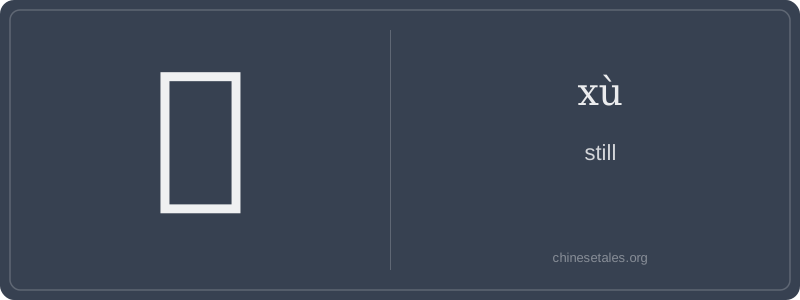
Carved onto Shang dynasty oracle bones, the earliest ancestor of 侐 wasn’t this character at all — it was a pictograph showing a person (人) standing beside a structure (宀), their posture bowed, hands folded, utterly motionless before an altar. In bronze inscriptions, the human figure simplified to 亻 (the 'person' radical), and the roof-like 宀 grew more stylized; by the Small Seal Script era, the right side solidified into 必 — not 'must', but a phonetic component hinting at the ancient pronunciation *suk*, later evolving to xù. Every stroke tells restraint: the left radical pins the figure to ritual space; the right half locks sound and motion inside the sacred boundary.
This visual grammar shaped its meaning: from 'a person standing motionless before the altar' to 'the profound stillness inherent in that act'. By the Han dynasty, 侐 appeared in the Shijing (Book of Odes): 'zhōng táng 侐 xī' — describing the ancestral hall’s reverent hush. Unlike 静 (which can describe a quiet room or a calm lake), 侐 was reserved for spaces imbued with lineage and sacrifice. Its shape — narrow, vertical, tightly bound — mirrors the posture of reverence: upright yet inward, silent yet speaking volumes through absence.
Forget everything you know about 'still' as in 'I am still waiting' — 侐 (xù) is a ghost of classical Chinese, whispering stillness like temple air after incense fades. It doesn’t mean 'still' as an adverb ('yet') or a verb ('to still the mind'), but rather a deep, sacred, almost architectural stillness: the hush inside an ancestral hall at dawn, the silence of polished stone untouched by wind or word. Its core feeling is *ritual quiet* — not absence of sound, but presence of reverence.
Grammatically, 侐 is nearly extinct in speech and rarely stands alone; it appears almost exclusively in literary compounds or classical-style phrases, always modifying nouns (e.g., 侐然, 侐静). You’ll never say 'xù wǒ zài děng' — that’s ungrammatical. Instead, it’s embedded like a fossil in poetic or ceremonial language: 'zhōng táng 侐 rán' (the ancestral hall is profoundly still). Learners mistakenly treat it like modern adverbs — but 侐 doesn’t modify verbs; it evokes atmosphere, like a single brushstroke defining emptiness in ink painting.
Culturally, 侐 lives in Confucian ritual texts and Song-Ming poetry, where silence isn’t passive but *charged* — a sign of respect, order, and cosmic harmony. Modern learners rarely encounter it outside classical anthologies or calligraphy scrolls. The biggest trap? Assuming it’s interchangeable with 静 (jìng) — but while 静 means general quiet, 侐 carries ancestral weight, solemnity, and a faint scent of aged wood and joss paper. It’s not 'still' — it’s *sanctuary-still*.