侍
Character Story & Explanation
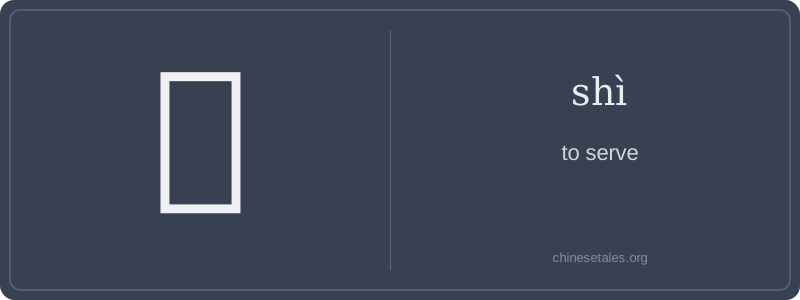
The earliest form of 侍 appears in bronze inscriptions around 1000 BCE: a figure (亻) standing beside a stylized 'scepter' or 'ritual staff' (a simplified version of the later 史 component), symbolizing a person authorized to act on behalf of authority — not a servant in chains, but a trusted aide holding delegated power. Over centuries, the right-hand side evolved from 史 (shǐ, 'historian/official') — emphasizing literacy and ritual competence — into the modern form where the top horizontal stroke and crossbar merged, leaving eight clean strokes: two for the human radical (亻), then six for the stylized, upright posture of disciplined attendance.
This visual logic held firm across dynasties: in the *Zuo Zhuan*, ministers are praised for their 侍君之道 (shì jūn zhī dào, 'the Way of serving the ruler') — loyalty enacted through precise language and timely counsel, not menial labor. Even in Tang poetry, 侍 often describes poets 'serving at court' (侍宴 shì yàn), their verses composed not for fame, but as acts of cultivated presence. The character’s shape — upright, balanced, quietly assertive — mirrors its meaning: service as dignified posture, not subservience.
At its heart, 侍 (shì) is about attentive, respectful service — not the transactional kind ('I’ll serve your coffee'), but the reverent, hierarchical kind you’d see in a palace or temple: bowing, anticipating needs, moving with quiet precision. The character radiates deference, not duty; it’s the verb behind 'court attendant' or 'personal aide to a scholar.' You’ll rarely hear it in casual speech today — it’s literary, formal, and slightly archaic, often appearing in historical dramas, classical texts, or bureaucratic titles like 侍衛 (shì wèi, imperial bodyguard).
Grammatically, 侍 is almost always transitive and requires an object — you serve *someone*, never just 'serve' abstractly. It’s commonly used in compound verbs like 侍奉 (shì fèng, to serve/attend to elders) or as part of honorific titles (e.g., 侍郎 shì láng, a high-ranking official in imperial ministries). Learners sometimes mistakenly use it like English 'serve' in passive constructions ('the meal was served') — but 侍 doesn’t work that way. No passive voice, no food-service context: this character serves people, not plates.
Culturally, 侍 carries Confucian gravity — it embodies the virtue of 恭 (gōng, reverence) in action. A common pitfall? Confusing it with 待 (dài, 'to wait for' or 'to treat') because they sound similar and both involve interaction. But while 待 is neutral or even strategic ('treat someone well to gain favor'), 侍 implies humility, status asymmetry, and unwavering presence. It’s less 'I’m handling this' and more 'I am here, at your side, ready — always.'