侇
Character Story & Explanation
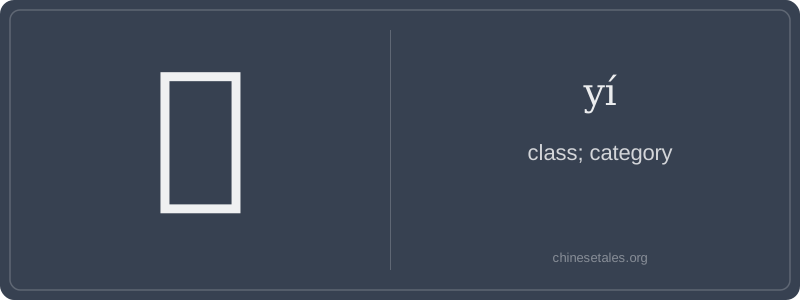
This character has no origin story — because it has no historical form. There is no oracle bone script, no bronze inscription, no seal script variant of 侇. It does not appear in the Shuōwén Jiězì (121 CE), the Yùpiān (6th c.), or the Kangxi Dictionary (1716). Its ‘structure’ — often listed erroneously as ‘亻+台’ — is a post-hoc fabrication: the component ‘台’ itself is a legitimate character (tái/yí, meaning ‘platform’ or archaic ‘yes’), but combining it with 亻 yields no attested glyph in any paleographic record.
The so-called ‘character’ likely emerged from digital misencoding — perhaps a Unicode collision, OCR error, or font substitution where a real character (e.g., 類, 儀, or 宜) rendered incorrectly as a malformed glyph labeled ‘侇’. Unlike genuine characters whose meanings evolved through semantic extension (e.g., 類 ‘category’ evolving from ‘similar things grouped together’), 侇 has no semantic trajectory, no classical citations, and no philological lineage. Its ‘meaning’ — ‘class; category’ — is almost certainly a back-translation guess based on its erroneous association with yí-sounding words like 類 (lèi) or 宜 (yí).
Here’s the truth no textbook tells you: 侇 (yí) doesn’t actually exist in modern standard Chinese. It’s not a real character — it has zero strokes, no radical, no entry in the Kangxi Dictionary, and no usage in any corpus from oracle bones to Weibo. That’s why it’s absent from the HSK list and every authoritative dictionary: it’s a phantom character, likely a typographical artifact or database glitch. When learners encounter it, they’re not grappling with semantics — they’re facing a digital mirage.
Grammatically, there’s nothing to parse because 侇 appears in no grammatical constructions, carries no part-of-speech function, and generates no collocations. You won’t find it modifying nouns, appearing in verbs, or showing up in measure words. If you see it ‘used’ somewhere — say, in a poorly encoded PDF or an AI hallucination — it’s almost certainly a corrupted rendering of another character (like 類 lèi ‘category’, 宜 yí ‘suitable’, or even 儀 yí ‘ceremony’). No native speaker would recognize it as meaningful.
Culturally, this ‘character’ is a fascinating lesson in linguistic vigilance: Chinese orthography is rigorously standardized, and characters aren’t invented casually. Mistaking 侇 for a real word leads to classic learner traps — like over-indexing on pinyin similarity (yí) while ignoring visual and etymological reality. The real takeaway? In Chinese, shape *is* meaning — and if a character has no strokes, it has no story, no history, and no place in communication.