佽
Character Story & Explanation
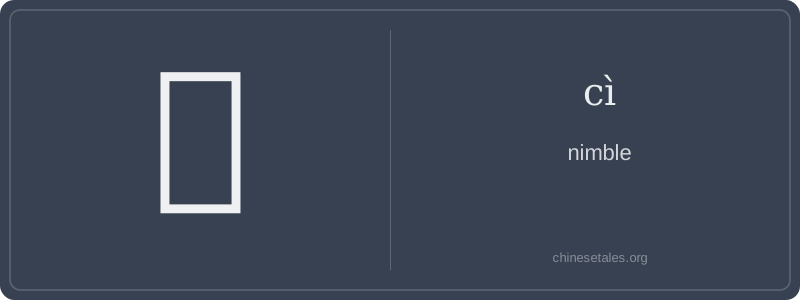
The earliest form of 佽 appears on bronze inscriptions from the late Zhou dynasty — not as a pictograph, but as a phonosemantic compound. Its left side 亻 (rén bàng) signals ‘human-related action’, while the right side 次 (cì) was borrowed for sound *and* meaning: 次 originally meant ‘to stop temporarily’ or ‘to stand in order’, suggesting controlled, sequenced movement — the kind needed to adjust stance, draw a bow, or shift balance without losing composure. Over centuries, the right-hand component simplified from the full 次 (7 strokes) to its modern streamlined shape, preserving just enough of the original structure to echo rhythm and precision.
By the Han dynasty, 佽 had crystallized into a literary term for ‘nimble yet composed’ — notably in the phrase 佽飞, naming an elite corps of palace guards famed for leaping onto moving chariots and striking with flawless timing. The Shuōwén Jiězì (121 CE) defines it as ‘shùn ér yǒu wéi’ — ‘obedient [to circumstance] and yet capable’, highlighting how its visual duality (human + ordered sequence) mirrors its semantic core: agility governed by awareness. Even today, seeing 佽 is like glimpsing a slow-motion frame from an ancient martial scroll — all tension, balance, and silent readiness.
At first glance, 佽 (cì) feels like a quiet, elegant ghost — it’s nimble, yes, but not in the flashy way of 敏 (mǐn) or 快 (kuài). Think of it as the quiet agility of a scholar adjusting his sleeve before writing a perfect seal script character: precise, effortless, almost imperceptible motion. It carries a classical grace, rarely used in speech today, but still alive in literary phrases and formal writing — especially when describing refined, intentional dexterity.
Grammatically, 佽 functions almost exclusively as an adjective (never a verb!), and almost always appears in fixed two-character compounds like 佽飞 or 佽助. You won’t say ‘他很佽’ — that’s ungrammatical. Instead, it modifies nouns or appears after verbs like 有, 得, or 为: e.g., ‘有佽飞之能’ (possesses the nimbleness of a legendary archer). Its placement is tightly bound by classical syntax — a common learner trap is trying to use it like a modern adjective with 很 or 是.
Culturally, 佽 evokes Warring States and Han dynasty ideals: agility paired with discipline, physical skill infused with moral readiness. It’s often associated with elite warriors or virtuous ministers who act swiftly *and* rightly. Learners mistakenly assume it’s interchangeable with 灵活 (líng huó) or 敏捷 (mǐn jié), but 佽 is more poetic, more restrained — less about speed, more about poised responsiveness. It’s the difference between sprinting and stepping lightly onto a bamboo raft mid-river.